Why Passenger Demand Forecasting at a granular level matters
Traditional planning cycles, seasonal schedules, and monthly roll-ups can’t keep pace with real-world variability: shifting booking patterns, weather, special events, and disruptions. Passenger demand is the thread that ties it all together. If airport operators can predict inflows and outflows through curb, check-in, security, immigration, boarding, and arrivals, they can right-size resources and make targeted, timely interventions. That translates to shorter queues, more consistent dwell times, and smoother peaks and troughs that ripple less across the day.
Variability of the demand from one day to another day is what keeps some of the capacity and operations planning folks up all night.
Traditional ways of estimating passenger demand through historical load factor (% of seats filled by flight) and applying a show up profile (also known as the distribution of time that passengers arrive at an airport) by route/market are very static ways of estimating demand. The precision is indeed lacking to be able to have a high degree of confidence in the numbers.
Airports are interested in predicting hourly and daily demand with a higher degree of confidence interval, and not just quarterly or annual demand to streamline resourcing allocation decisions.
Use Case – Profile Estimation for a Typical Day at a Major Indian Airport
Avinia Labs, using several years of tower data for a major Indian airport, has demonstrated the utility of machine learning (ML) models to forecast typical weekday and weekend patterns, as well as the busiest days of the year such as Diwali or Christmas Eve.
In this use case SARIMA model was used, which is among the more popular time series forecasting techniques.
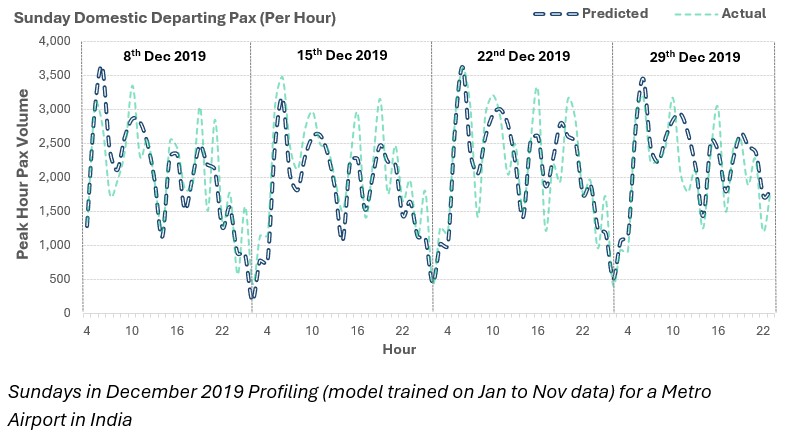
11 months (January to November) 2019 of tower data was used to train the model to produce daily and hourly profiles for the month of December. Specifically, the weekly seasonality was tested and separate daily profiles for a Friday and Sunday was tested against actuals. This also included testing the busiest travel day in the year, which fell on Christmas Eve.
The comparison is shown in the graphic below. It shows a close match between the predicted values and actuals except for the busiest day of the year outlier. Busiest travel days require bespoke models instead of one-size-fits-all averages, improving accuracy when passenger experience is most sensitive. Modelling the busiest day would require training the model on a few years of the busiest day to enable it to predict with a higher precision going forward.
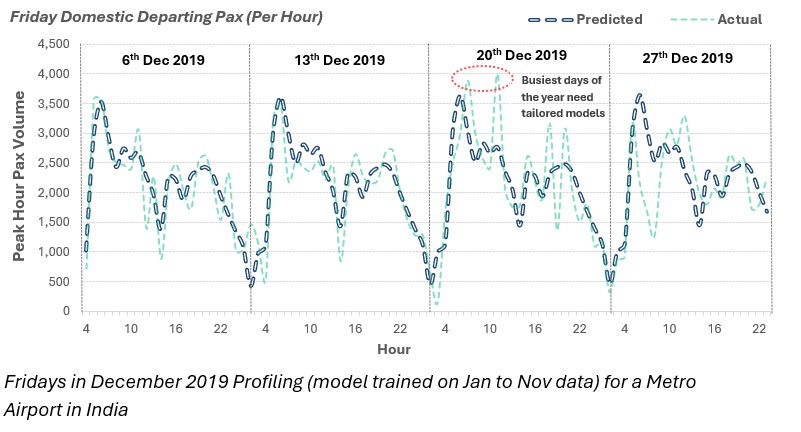
However, there are some limitations as with any model. Larger datasets are required to improve accuracy. As models are exposed to larger, more diverse datasets, they learn from anomalies, become more robust across airport types, and improve reliability. Modeling extreme cases such as the busiest day of the year will require representative data to train the model for busiest days over several years.
Forecasting is part science and part Art. Any application without a subjective context or interpretation can be misleading. Patterns tend to overestimate “causality”. Any constraints and other “temporal” factors need to be considered.
Got a use case idea? Just hit reply and tell us what analysis you would find most useful— we can crunch the numbers at your beloved airport.