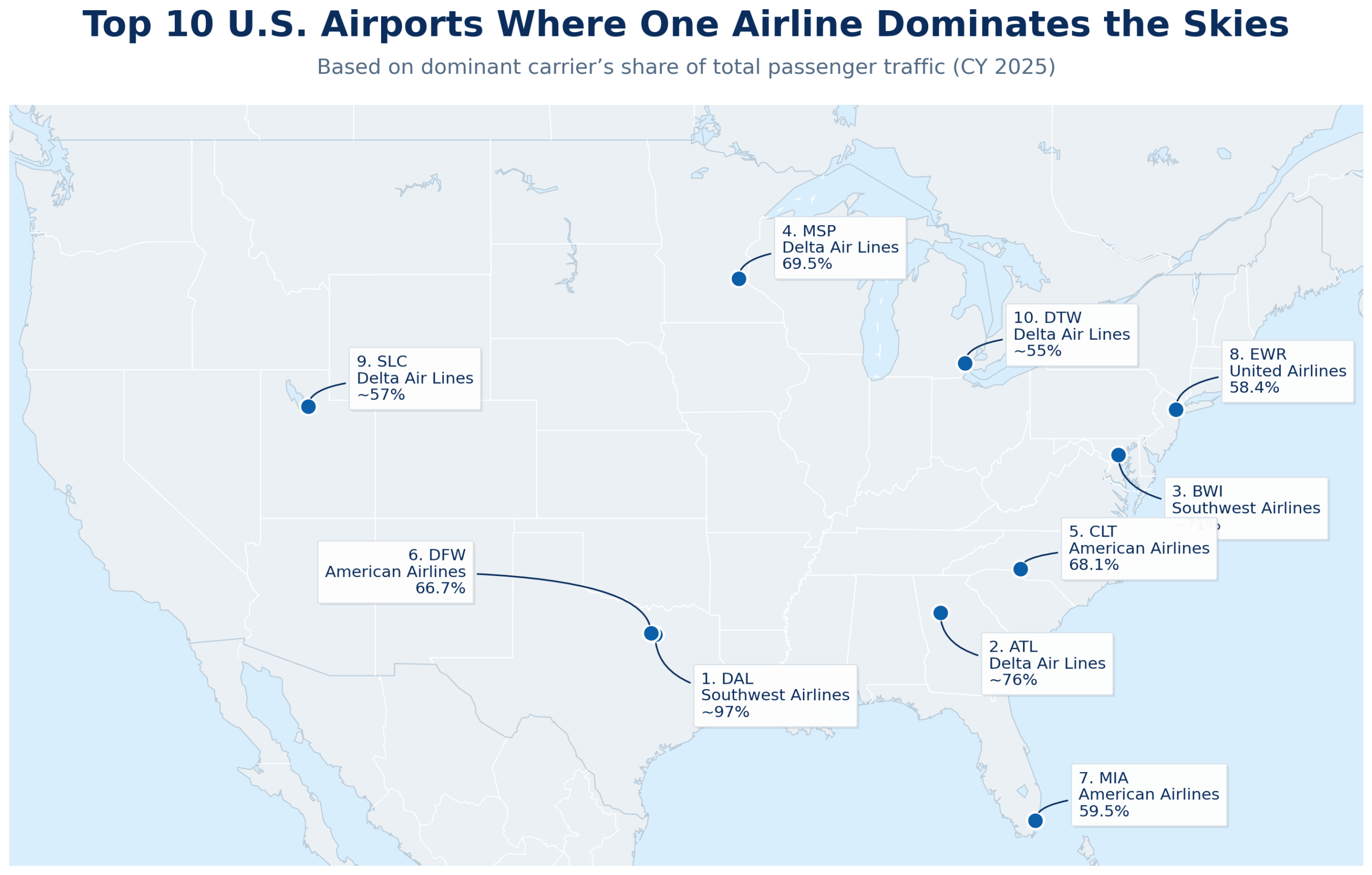
At Dallas Love Field, Southwest Airlines operates roughly 18 of the airport’s 20 gates and carries close to 97 percent of all passengers — a level of control that very few major US airports have. Love Field is the extreme case, but it is not an outlier so much as the clearest example of a pattern that defines how American commercial aviation actually works: many of the country’s busiest airports are not competitive marketplaces so much as fortress hubs, built around a single carrier’s network, gate leases, and pricing power. This ranking looks at the ten US airports where that concentration runs deepest — and at what that concentration has done to fares at each one. The honest answer is more interesting than “dominant carrier, higher prices”: it depends entirely on who the dominant carrier is.
Methodology
Rankings are based on each airport’s dominant carrier’s share of total passenger traffic for calendar year 2024, compiled from FAA and DOT-sourced airport traffic data. One caveat worth stating plainly: concentration measured by passengers or seats can differ meaningfully from concentration measured by flight count, since a carrier can operate a large share of an airport’s departures using smaller regional aircraft.
The fare data is from the US Department of Transportation. DOT publishes a passenger-weighted average fare for each airport’s city-pair markets and compares it with the national average across all other domestic city-pairs. This comparison produces a fare premium — the percentage by which an airport’s average fares are higher or lower than in the rest of the country. This is DOT’s official methodology for measuring the impact of hub dominance on airfares, and the data is available through DOT’s public data portal.
The Ranking
The most concentrated major airport in the country. Southwest’s control was shaped by the Wright Amendment, which confined Love Field to short-haul, Texas-adjacent service for decades and let Southwest build an uncontested base there before the restriction was repealed. DOT’s Q1 2026 data shows Love Field’s fares running 2.15 percent below the national average — near-total single-carrier control, and travellers are still paying less than the country. That gap has widened since Q1 2025, when Love Field was exactly at the national average (−0.33%).
The world’s busiest airport by passenger volume is also one of its most concentrated. Delta carried over 70 percent of the airport’s total passenger traffic as of 2023, and has continued expanding capacity there since, planning roughly 968 daily departures and 1.1 million weekly seats from ATL for summer 2025 alone. DOT’s data puts Atlanta’s Q1 2026 fare premium at 16.9 percent above the national average — essentially unchanged from a year earlier (16.85%) but up from 14.3 percent two years ago.
Southwest built BWI into its Mid-Atlantic anchor after entering the market in the late 1990s, and it remains the airport where the carrier’s East Coast network is most concentrated. Fares here run essentially flat to the national average (−0.05% in Q1 2026), following the same pattern as Love Field: Southwest’s dominance has not translated into a fare premium, and BWI has moved steadily toward parity from a −4.8 percent discount two years ago.
A legacy Northwest Airlines hub absorbed into Delta’s network through the 2008 merger, MSP has kept its concentrated hub structure largely intact under Delta ownership. Its fare premium has climbed sharply — from 3.7 percent in Q1 2024 to 13.3 percent in Q1 2026, the single largest two-year increase of any airport on this list.
Another merger legacy — CLT was US Airways’ primary East Coast hub before the 2013 American Airlines–US Airways merger, and American has continued to grow it as a connecting point between the Northeast, Southeast, and Europe. Charlotte’s fare premium reached 18.7 percent in Q1 2026, its highest point in the nine quarters of data reviewed, and up from 13.8 percent just a year earlier.
American’s largest hub by scale, and the clearest counterpoint to Southwest’s dominance twenty minutes away at Love Field — together the two airports illustrate how thoroughly the Dallas–Fort Worth market is split along carrier lines rather than genuinely contested at either airport individually. Unlike most of the legacy-carrier hubs on this list, DFW’s fare premium has actually been falling — from 20.2 percent in Q1 2024 to 13.9 percent in Q1 2026 — even as American’s passenger share has stayed roughly steady, worth watching as a possible signal of intensifying connecting-traffic competition through the airport.
American’s gateway to Latin America and the Caribbean, where its dominant position reflects decades of consolidated connecting traffic to a region few competitors have matched route-for-route. Miami’s fare premium is comparatively modest and has drifted up slightly, from 3.9 to 6.7 percent over two years — the lowest premium among the legacy-carrier hubs on this list, plausibly reflecting the international competition American faces there from Latin American and Caribbean carriers that a purely domestic hub doesn’t.
United’s primary New York-area international gateway, concentrated enough that a single carrier’s operational disruptions at EWR — as the airport has shown repeatedly in recent years — can register as a national air traffic control story. Newark’s fare premium has actually declined, from 9.7 to 6.9 percent over two years, the second-largest improvement on this list after DFW.
A former Western Airlines hub inherited by Delta through its 1987 acquisition, SLC remains Delta’s primary gateway to the Mountain West and a connecting point for its western transcontinental network. It carries the second-highest fare premium on this list at 19.2 percent and has stayed elevated throughout the period reviewed — never dropping below 17 percent.
The lowest share on this list is still a majority position — another Northwest Airlines legacy hub, and Delta’s primary Midwest connecting point since the 2008 merger. Detroit’s fare premium has eased modestly, from 13.3 to 10.5 percent over two years, tracking a similar gentle decline to Newark and DFW.
What the Pattern Shows
Six of the ten airports on this list trace their concentration directly to a merger — Northwest into Delta, US Airways into American, Western into Delta — rather than to organic single-carrier growth, which says something important about how hub dominance actually forms in US aviation: it is usually inherited wholesale through consolidation, not built route by route against active competition. The remaining four — Love Field and BWI for Southwest, DFW and MIA for American — reflect deliberate network strategy instead, built around gate control, connecting-traffic economics, or regulatory history specific to that airport.
The DOT fare data adds a distinction the concentration numbers alone don’t suggest. Every merger-inherited, legacy-carrier hub on this list — Atlanta, Charlotte, Minneapolis, Salt Lake City, Detroit — shows a fare premium of at least 10 percent, and in several cases fares are substantially higher than the national average. Unlike most major hubs, Southwest’s two primary hubs — Love Field and BWI — do not carry a fare premium. Love Field consistently operates at a discount to the national average, while BWI remains broadly flat — and this pattern held in every quarter. Southwest’s entire commercial model is built on being the low-fare disruptor, including at airports where it faces almost no competition, while legacy carriers price hub-dominated markets closer to what the connecting-network economics and business-travel mix will bear.
For airport planners and investors, the distinction matters. A merger-inherited fortress hub carries different long-term risk than a strategically built one: the former can, in principle, be contested if a merger-driven carrier ever pulls back capacity, while the latter tends to reflect structural advantages — gate leases, connecting-bank scheduling, feeder networks — that are far harder for a new entrant to displace regardless of how the incumbent arrived there.
The trend lines are worth watching alongside the fare levels. Over the past two years, three legacy hubs — DFW, Newark, and Detroit — have seen their fare premiums narrow, even though the dominant carriers’ passenger shares remained broadly stable. Minneapolis and Charlotte moved in the opposite direction, with both recording sharp increases in fare premiums. That divergence among similar merger-legacy hubs suggests fare premiums at concentrated airports are not simply a fixed function of market share; something route-specific — connecting-bank competition, low-cost-carrier entry on individual city pairs, corporate contract dynamics — is doing real work underneath the airport-level averages, and any single number on this list is a starting point for that deeper route-level question, not the end of it.
Sources: DWU Consulting, airport-finance and hub-economics research (CY2024 airport-level carrier concentration); Delta News Hub, “Delta at ATL: Bigger and bolder at the world’s largest airline hub in summer 2025”; SimpleFlying, “American Airlines Will Operate 88% Of Charlotte International Airport’s March Flights” (March 2024, flight-count basis, cited for comparison only); SimpleFlying, “The Other 4%: Who Serves Dallas Love Field Besides Southwest?” (headline-level corroboration of Southwest’s ~96–97% share).