Non-aeronautical income per passenger across eight major Indian airports varies significantly. Duty free explains almost none of it.
India is building terminals faster than at any point in its aviation history. Three greenfield airports have entered commercial service in the space of a single year — Navi Mumbai, Noida International, and on 17 August, Bhogapuram. DIAL has just filed a ten-year master plan taking Delhi from 106 to 125 million passengers by 2032. And on 4 August the Public Private Partnership Appraisal Committee cleared eleven AAI airports for 50-year concessions across five bundles, with concessionaire capital expenditure estimated at ₹8,622 crore. The interior design decisions being locked into all of that concrete over the next thirty-six months will determine commercial performance for the following two to three decades.
Planners and operations teams are briefed to minimise time and cognitive effort between kerb and gate; commercial teams to maximise dwell and spend. One wants passengers to move faster and the other slower, and the standard resolution is a negotiated compromise — signage deliberately a little less direct, a retail frontage deliberately a little more obstructive. That compromise is unnecessary, and Indian operators’ own tariff filings now contain enough evidence to show why.
What the Tariff Filings Actually Show
The AERA tariff consultation process requires operators to disclose revenue-share asset income in detail, broken out by concession head and normalised against traffic. That produces a consistent, audited, publicly-filed measure of what each airport earns per passenger from its commercial estate.
One caveat matters before any of the numbers do. These are income to the operator — concession fees, licence fees, and revenue share — not gross passenger spend. Cross-airport comparison is valid because the definition is consistent; comparison against global passenger-spend benchmarks is not.
The spread between the best and worst performing airports in India, under the same regulator, in the same year, is not a small finding — and none of these are marginal assets. Between them they handle the overwhelming majority of India’s commercial traffic.
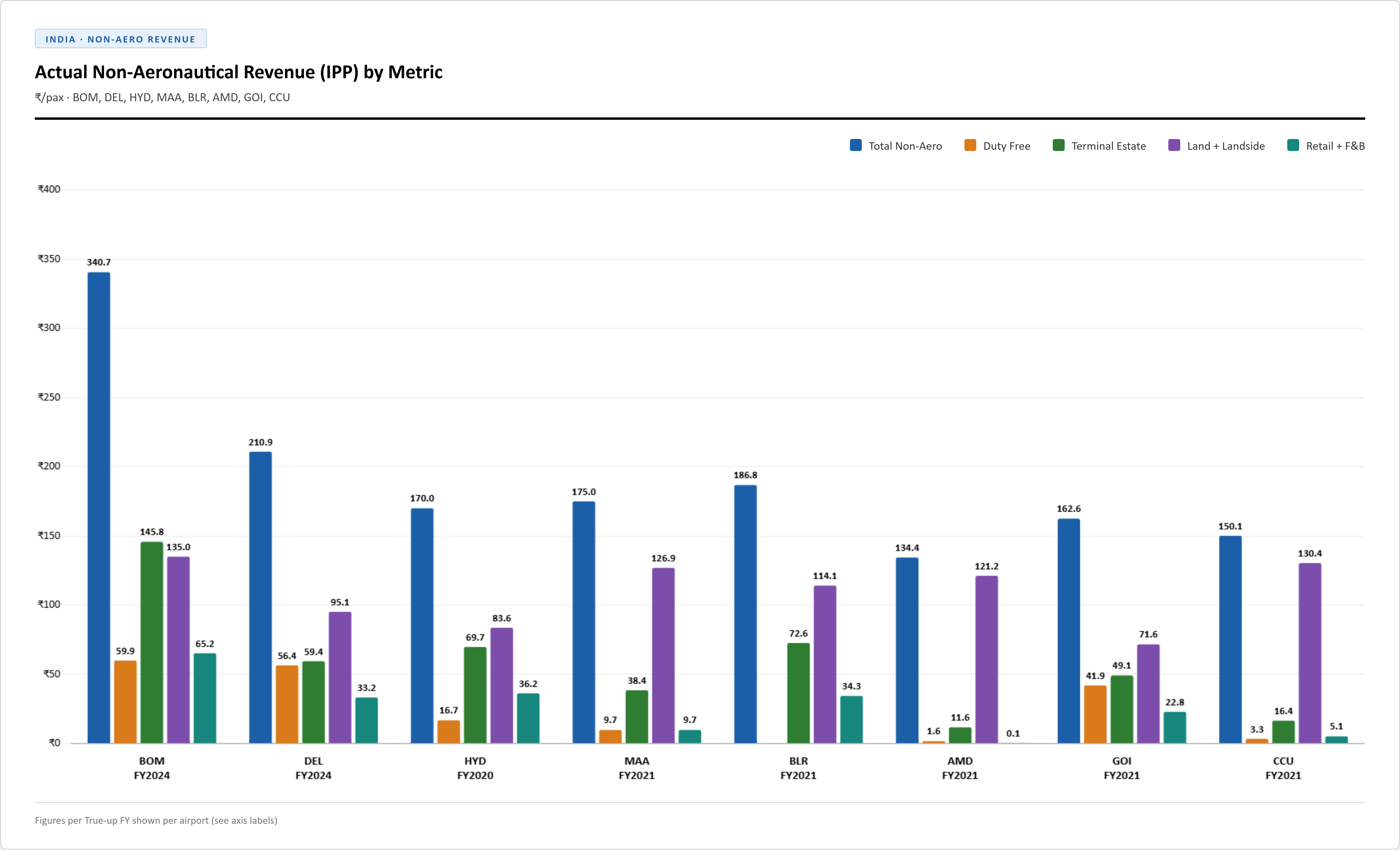
Table note: FY2026, income to the operator per passenger, all heads denominated against total passengers except duty free. Terminal estate = retail, F&B, advertising, lounge, in-flight kitchen, excluding duty free. Land + landside = lease and rental, car parking, miscellaneous contract-linked heads. Totals also include an IT line in neither grouping. “n/r” = no separate line in that filing, not absence of activity. Chennai, Ahmedabad, Dabolim, and Kolkata report no separate retail line, so their retail + F&B figure is F&B alone. Source: AERA tariff consultation filings (multi-year tariff proposals and true-up submissions).
Duty Free Explains Almost None of It
Duty free contributes 26.8 percent of Delhi’s non-aeronautical income per passenger — the highest share in the set — 25.7 percent of Dabolim’s, 17.6 percent of Mumbai’s, 9.8 percent of Hyderabad’s, 5.5 percent of Chennai’s, 2.2 percent of Kolkata’s, and 1.2 percent of Ahmedabad’s. Whatever separates the top of this table from the bottom, it is not international traffic mix.
That is the more useful finding, because it means the variation sits in the ordinary commercial estate — the part that terminal design, tenant mix, and landside planning actually control. And that estate splits cleanly in two, along a line that turns out to matter a great deal.
Two Estates: One You Design, One You Wait For
Group the heads by what produces them. The terminal commercial estate — retail, food and beverage, advertising, lounges, in-flight kitchen — is earned inside the building, from passengers, and is shaped by layout, sight lines, tenant placement, and dwell. The land and landside estate — lease and rental, car parking, and the miscellaneous contract-linked heads — is earned from real estate and long-dated contracts, and is shaped mainly by how long the airport has existed and how much developable land sits around it.
Bengaluru is fifth of eight on headline yield and third on the terminal estate — level with Delhi, within a rupee and a half per passenger, on barely half Delhi’s traffic. Narrow to retail and food and beverage, the two most design-sensitive heads charged across every passenger in the building, and the benchmarks vary considerably.
The split is clearest as a share. Bengaluru takes 31.7 percent of its non-aeronautical income from land and landside, Mumbai 34.1 percent, Delhi 34.7 percent — roughly a third, with the terminal carrying the rest. Chennai takes 50.8 percent, Ahmedabad 68.2 percent, Kolkata 81.6 percent. The airports at the bottom are not simply earning less per passenger; they are earning what they do earn from land, parking, and contract-linked heads rather than from anybody inside the building.
Dabolim rules out the obvious objection that this is simply about scale. It is the smallest airport in the set, with the lowest land and landside income of the eight at ₹30.7 per passenger — no land bank, a constrained terminal shared with a naval air station. It still earns significantly more per passenger from food and beverage than most Indian airports. Small, constrained, and land-poor does not stop an airport converting its passengers.
The two estates also behave differently over time, which matters for anyone modelling a fifty-year concession. Land and rental income compounds slowly and reliably as a land bank is developed and contracts reset upward; it is close to a bond. Terminal commercial income is largely set the day concept design is frozen, and after that it can be re-tendered but not re-planned. Delhi shows how far re-tendering gets you: F&B income per passenger sat at ₹13.13 in FY2023 and ₹13.14 in FY2024; this is expected to substantially increase with the new Terminal 1. Renegotiation changes the price. It does not change the building.
Certainty, Not Confusion, Is What Sells
The mechanism runs opposite to the shopping-mall instinct that mild disorientation encourages browsing. In a terminal, the cost of getting lost is not an extra lap of the mall; it is a missed flight. A passenger who cannot see where the gates are will walk toward them anyway, quickly, and will not stop. A passenger who can see the gate corridor from the concession level, and knows it is four minutes away, will sit down. Legibility is not a constraint on retail. It is a precondition for it.
The corollary is that upstream processing belongs in the commercial business case, not just the level-of-service one. The relationship between security queuing and downstream retail conversion is negative: friction at check-in and screening does not shift spending later in the journey, it destroys it. A passenger who has spent twenty-five unpredictable minutes in a queue does not arrive at the concession level with twenty-five minutes of pent-up demand; they arrive behind their own schedule and unwilling to risk a transaction that might cost them their gate. India has a structural advantage here it is not yet monetising. DigiYatra is being justified almost entirely on throughput and passenger-experience grounds.
The Digital Layer Is an Amplifier, Not a Substitute
Digital wayfinding is now a standard line item in Indian terminal programmes, moving toward AI routing engines and augmented-reality guidance tied to live flight data and advertising inventory. The commercial logic is attractive: a routing system that knows where a passenger is going can also know what is on the way.
Two cautions. A terminal only navigable with a phone is not navigable — app penetration remains a minority of passengers, and India’s linguistic diversity makes architectural legibility more valuable here, not less. And these systems optimise for the fastest route by default, which is not the route a commercial team would choose.
Avinia’s View
Brief wayfinding and commercial planning as a single workstream, under a single accountable lead, before concept design is fixed. The decisions that determine both — hall geometry, ceiling height, the position of vertical circulation, the sight line from the recomposure zone to the gate corridor — are made in the first ten percent of the design programme and cannot be recovered later with signage or fit-out.
Model discretionary dwell, not total dwell — total dwell less queuing, less walking distance, less the schedule buffer passengers hold in reserve. It predicts spend far better than the headline number commercial cases usually run on, and in many existing Indian terminals the cheapest way to raise concession revenue is not a retail refresh but a checkpoint that runs to a predictable time.
For the eleven-airport PPP round specifically, do not benchmark on the headline metro number. Bidders are quoting a per-passenger fee indexed to domestic traffic, and every one of the eleven on offer — Amritsar, Kangra, Varanasi, Gaya, Kushinagar, Bhubaneswar, Hubballi, Raipur, Aurangabad, Tiruchirappalli, and Tirupati — is a regional, overwhelmingly domestic AAI airport with limited land bank, limited meaningful duty free activity, and limited developed landside estate.
Ahmedabad and Dabolim earn ₹18.7 and ₹27.6 per passenger from inside the building; Bengaluru earns ₹106.3, level with Delhi, for the price of a design brief that is a rounding error against ₹8,622 crore. The terminal estate is available at first close and is decided in the first ten percent of the design programme.
The terminals that outperform commercially in this build cycle will not be the ones with the densest retail frontage. They will be the ones where a passenger, thirty seconds after entering the building, knows exactly where they are going and how long it will take — and therefore feels free to do something else first.
Source: Draft — AERA tariff consultation filings (multi-year tariff proposals and true-up submissions), Delhi, Mumbai, Bengaluru, Hyderabad, Chennai, Kolkata, Ahmedabad, and Goa (Dabolim).