The Market Being Transferred: VTZ Traffic at a Glance
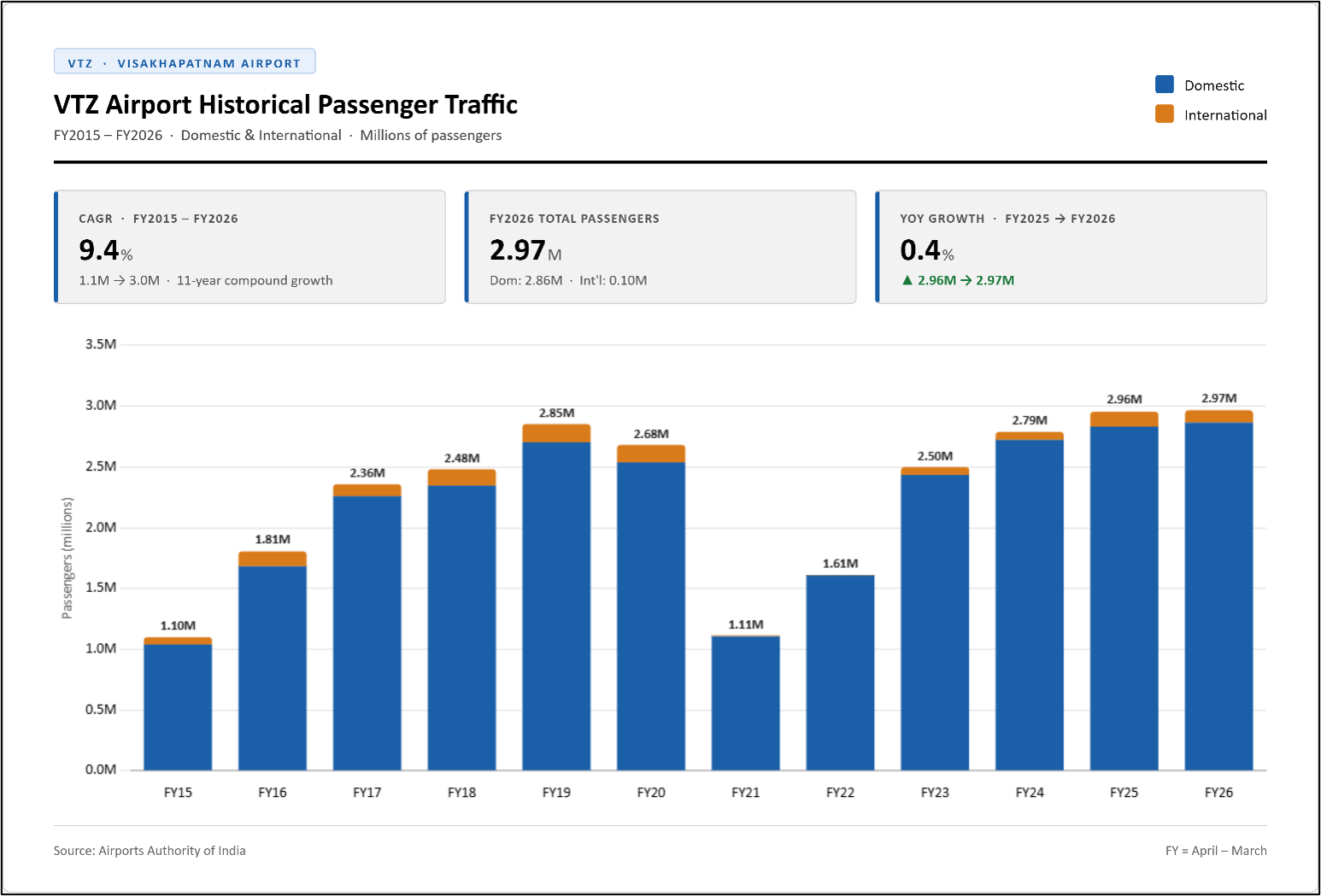
Visakhapatnam Airport (IATA Code: VTZ) is the busiest airport in Andhra Pradesh and, as of FY2026, ranks among the top 25 commercial airports in India by passenger volume. Over the past decade, the airport has experienced strong and sustained growth, with annual passenger traffic increasing from 1.1 million passengers per annum (MPPA) in FY2015 to 2.96 MPPA in FY2026, representing growth of nearly 170 percent. This expansion has firmly established VTZ as the primary aviation gateway for North Coastal Andhra Pradesh.
Operating as a civil enclave within a military airbase, Visakhapatnam Airport faces restrictions on operating flexibility (such as remote overnight stands), capacity expansion (current terminal capacity pegged at 3.6 MPPA), and airline slot availability.
The transition to Bhogapuram is therefore not simply an aspirational infrastructure upgrade; it represents an opportunity for unlocking the market’s long-term growth. Bhogapuram has potential for growth as a regional market feeding into the airlines’ hubs in the near term, with more traffic expansions in the long term.
Airline Market Structure at VTZ: What Is Moving to Bhogapuram
Understanding who operates at VTZ and in what proportion is essential for assessing the transition risk. An airline with a concentrated, single-type narrowbody fleet and a bank-structured domestic schedule faces a fundamentally different rebasing challenge than one operating a more diverse fleet mix. The June 2026 departure schedule, representing the last full month of operations before the anticipated transition to Bhogapuram in July, provides a detailed snapshot of the market expected to transfer upon the commencement of operations at the new airport.
Source: Cirium
Overall Market Share — June 2026 (Departures)
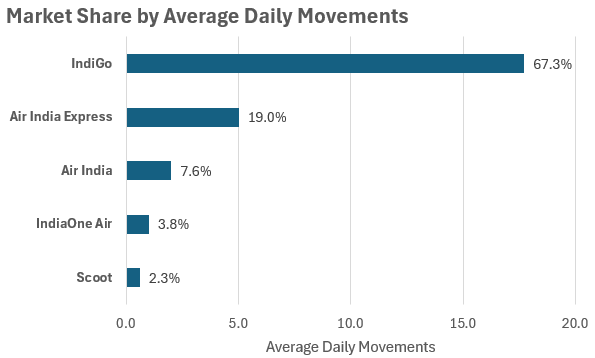
The VTZ departure market in June 2026 is served by five operators across 789 scheduled departure movements, offering 1,37,484 seats. The domestic segment accounts for 95.7 percent of total departures (755 of 789) and 95.4 percent of total seats.
IndiGo holds a dominant position at VTZ, operating an average of 17.7 daily departing ATMs. Its network spans 11 destinations, comprising ten domestic routes — Hyderabad, Bengaluru, Delhi, Chennai, Mumbai, Kolkata, Vijayawada, Tirupati, Raipur, and Kurnool — and one international route to Abu Dhabi. Although the Abu Dhabi service is currently suspended due to the West Asia crisis, it is expected to resume from mid-August 2026, according to IndiGo’s booking schedule.
The Overnight Switchover Challenge
At 23:59 on July 7, 2026, Visakhapatnam Airport is expected to close — with the VTZ IATA code officially porting over to Bhogapuram — to scheduled commercial traffic for the last time. On July 8, the first scheduled departure from Alluri Sitarama Raju International Airport at Bhogapuram is wheels up. This is subject to all the operational and navigational technicalities of the transition going through seamlessly — a task that is easier said than done.
A simultaneous shutdown and launch involving multiple airlines and ground service providers, air traffic control reorganisation, and approximately 4,200 daily passengers on opening day (if all flights move from the existing airport) whose entire airport geography will have changed overnight.
The Bhogapuram transition is not unique globally. Bangkok, Hong Kong, and Munich have all executed major airport switchovers. But the Indian context adds layers of complexity that distinguish this transition from its international precedents.
Scoot has made the first formal airline transition announcement, confirming that all its Visakhapatnam operations anchored on the Singapore route will move to Bhogapuram from July 8, 2026. The VTZ IATA code will transfer seamlessly to Bhogapuram, preserving the code’s continuity in global distribution systems. The other carriers are in a wait-and-watch mode, with certain technical considerations that need to be resolved before the first flight can land at Bhogapuram.
The Reality: Why VTZ Cannot Coexist With Bhogapuram
‘Site Clearance’ approval for the Bhogapuram Greenfield airport was given by GoI to GoAP with a provision that scheduled commercial operations at the civil enclave at the existing Vizag naval airfield will be stopped for a period of 30 years, once operations at the Greenfield airport at Bhogapuram commence. Thereafter, it is up to AAI to restart scheduled commercial operations at the existing Vizag airport as per requirement.
From July 9, the Indian Navy assumes complete control of the restructured Visakhapatnam airspace. Since the IATA code will be allocated to the new airport, there is no fallback. If Bhogapuram experiences an inaugural-day operational failure — ATC miscommunication, ground handling delays, baggage system faults, or surface access congestion — there is no option to route the flight to the old airport. The operational risk sits entirely with the airport operator, the airlines, and the ecosystem of ground service providers at Bhogapuram.
The Regulatory Signal: AERA’s Ad Hoc Tariff Structure
AERA’s tariff order represents the final regulatory gate before commercial operations. The authority approved an interim tariff framework for GVIAL that sets the commercial baseline for Bhogapuram’s opening phase. These are ad hoc tariffs — not the first control cycle determination — and are explicitly designed to provide a regulatory framework during the transition period.
AERA-Approved Ad Hoc Tariffs — Bhogapuram International Airport (effective July 8, 2026)
| Category | Passenger Type | UDF — Departure | UDF — Arrival |
|---|---|---|---|
| Domestic | Adult | ₹835 | ₹355 |
| International | Adult | ₹1,255 | ₹545 |
| Airline Landing Fees (per MT of MTOW) | Domestic: ₹1,400/MT | International: ₹1,975/MT | New route incentive: 60% of standard |
Source: AERA Order
The tariff structure carries direct implications for airlines and passengers. The domestic departure UDF of ₹835 and international departure UDF of ₹1,255 are materially higher than what passengers paid at VTZ, where tariffs reflected an AAI-managed naval enclave with minimal capital cost recovery requirements. When combined with the higher surface transport costs from the 45 km relocation, the total cost of accessing air travel from Vizag will rise meaningfully in the transition’s first year for the average price-sensitive domestic traveller.
Airlines are also subject to structured landing fees: domestic carriers pay ₹1,400 per metric tonne of MTOW, and international carriers ₹1,975 per MT. AERA has embedded a route incentive mechanism — airlines expanding existing routes pay 80 percent of the standard landing fee, while those launching new routes pay only 60 percent. Night domestic landings (23:00–06:00) attract just 25 percent of the standard rate, and freighter aircraft are exempt entirely. Parking is free for the first two hours. These incentives are calibrated to attract new connectivity to a market where airlines have historically been slot-limited, not demand-limited.
UDAN services retain their existing exemptions, which matters for connectivity to tier-2 points such as Jeypore, Raipur, Bhubaneswar, and Kurnool where price sensitivity is highest and where the incremental UDF burden could most directly affect load factors.
The Operational Shift for Airlines
Airlines operating at VTZ must simultaneously rebase to Bhogapuram. The transition involves four distinct operational workstreams that must be completed in parallel.
Slot Migration and Schedule Recalibration. All VTZ airport slots expire at the moment of closure. Bhogapuram’s slot coordinator has been issuing provisional allocations for the July 8 schedule, but airlines must individually validate their timing against the new airport’s infrastructure constraints — different runway orientation, different taxi distances from gate to threshold, and a significantly different airspace entry and exit geometry than VTZ. IndiGo, which operates the majority of routes at Vizag, faces the most complex rescheduling task: its bank structures built around VTZ’s demand profile and turnaround times must be recalibrated for Bhogapuram’s physical layout.
Ground Handling Realignment. Every ground service contract written for VTZ is void at Bhogapuram. Airlines must negotiate new agreements with ground handlers establishing operations at the new facility. Ground handlers must position their own equipment — baggage tugs, belt loaders, aircraft stairs, fuel bowsers — at a new location 45 kilometres from where their maintenance and storage facilities may currently be based. The transition period creates a temporary spike in ground handler capital requirements and a meaningful risk of equipment shortfalls on day one.
Crew Positioning and Logistics. Flight crew and cabin crew positioned in Vizag must commute to Bhogapuram via NH-16 or be repositioned closer to the new airport. The hotel and accommodation infrastructure around Bhogapuram in Vizianagaram district remains nascent relative to Vizag city. Carriers operating early morning or late evening departures — which attract the 25 percent night landing fee discount AERA has structured — will need to establish crew transport and rest protocols that did not previously exist.
Cargo and Freight Ecosystem Transition. Cargo operators who have invested in bonded warehouse facilities near VTZ face a displacement problem. Bhogapuram’s Phase 1 includes dedicated cargo infrastructure, but the customs clearance and freight forwarding ecosystem around the existing airport does not relocate automatically. The transition period — likely 60 to 90 days from opening — will see split operations as cargo documentation systems, Custom House Agent licences, and airline cargo agents establish themselves at the new facility.
The Passenger Experience Gap: 45 Kilometres Is Non-Trivial
VTZ’s defining commercial advantage has historically been its proximity to the urban core. The airport is located approximately 8–12 km from Visakhapatnam city centre, providing a travel time of around 20–35 minutes from key catchment areas such as RK Beach, the central business district, and the main railway station.
Bhogapuram Airport, by contrast, is located approximately 45 km north of Visakhapatnam along NH-16 in Vizianagaram district. For passengers originating from central Visakhapatnam, the Steel Plant Township, and other southern catchment areas, the shift to Bhogapuram is expected to increase surface travel times to approximately 45–75 minutes under normal traffic conditions.
To support the transition, APSRTC and private operators have announced dedicated bus services along the Visakhapatnam–Bhogapuram corridor, while ride-hailing platforms are expanding service coverage in the region. Although Bhogapuram’s master plan includes an airport access road corridor and longer-term rail and metro connectivity provisions, these initiatives are not expected to be operational at the time of the airport’s inauguration. Consequently, NH-16 will serve as the primary access route during the airport’s initial years of operation. This creates a degree of network vulnerability, as maintenance activities, traffic incidents, or flooding during the monsoon period could significantly affect passenger access with limited alternative routing options available.
The NHAI interchange at Savaravalli and the first phase of the VMRDA Master Plan road network are nearing completion and are expected to provide meaningful connectivity improvements ahead of the airport’s launch. However, the coastal corridor, flyover programme, and proposed metro extension — the three infrastructure interventions most capable of materially improving passenger access between Visakhapatnam and Bhogapuram — remain in planning, tendering, or early execution stages, with expected completion timelines extending into the 2027–2029 period and beyond.
Surface access costs are also expected to increase materially during the transition period. Taxi fares between Visakhapatnam and Bhogapuram Airport are estimated at approximately ₹2,000 per trip. Combined with the higher UDF structure approved by AERA, the overall cost of air travel access for passengers in the Visakhapatnam market is expected to increase during the airport’s initial years of operation.
For airlines, particularly those operating UDAN-supported and other price-sensitive regional routes, these additional access costs may create friction within the market. The primary risk is not a loss of traffic to competing airports — given the absence of viable alternatives — but rather a moderation in travel frequency among discretionary travellers, a segment that contributes disproportionately to domestic passenger volumes and load factors in the Visakhapatnam market.
Global Comparisons: What the International Record Says
Airport relocations are rare enough that each one is, in some sense, unique. But the global and domestic record does yield a consistent set of risk factors and success conditions that are directly applicable to the Bhogapuram case.
Three international precedents are instructive.
Hong Kong — Kai Tak to Chek Lap Kok (July 1998). Hong Kong’s overnight switch from Kai Tak to the new Chek Lap Kok facility remains the benchmark for rapid airport transitions globally. The switchover took six hours — the final Cathay Pacific flight departed Kai Tak at 00:23 on July 6, and the first commercial departure from Chek Lap Kok took off at 06:00. The transition succeeded because of two years of intensive parallel testing, including full-scale operational simulations with live aircraft. Ground handlers, cargo operators, and airlines had pre-positioned equipment under a coordinated regime managed by the Airport Authority. The critical lesson: a successful overnight switchover requires parallel readiness infrastructure well in advance of the cut date.
Munich — Munich-Riem to MUC (May 1992). Munich’s transition on 17 May 1992 is instructive for its workforce preparation. Approximately 11,000 airport and airline staff were trained over an 18-month period specifically for the new facility’s operating model. The cut itself was executed in a single night with zero reported disruption to scheduled services. The lesson for Bhogapuram: staff familiarisation at the new facility, not just physical infrastructure completion, is the decisive variable.
Bangkok — Don Mueang to Suvarnabhumi (September 2006). Bangkok’s transition is the cautionary tale. Suvarnabhumi opened on September 28, 2006, replacing Don Mueang as Bangkok’s international hub. Within days, the new airport was overwhelmed: luggage handling failures left thousands of bags stranded, runway cracking was discovered on newly built surfaces, and the ground transport system underperformed badly. The root cause was compressed testing timelines. When political pressure forced the opening ahead of full readiness, the ecosystem was not prepared. Don Mueang was eventually reopened for low-cost domestic operations, fragmenting Bangkok’s traffic across two airports for more than a decade — a costly and avoidable outcome.
India’s Own Precedents: Bangalore and Hyderabad (2008)
India has navigated overnight airport transitions before. On March 23, 2008, Hyderabad’s Begumpet Airport ceased commercial operations as Rajiv Gandhi International Airport (RGIA) opened on the city’s southern outskirts. Seven weeks later, on May 24, 2008, Bangalore’s HAL Airport closed overnight as Kempegowda International Airport (BIAL) commenced operations approximately 35 kilometres from the city centre. Both were complete overnight cutoffs — no fallback airport, no shared operating period. Both broadly succeeded.
The airline landscape was materially simpler: fewer carriers, thinner route networks, lower daily movement counts, and ground handler operations considerably less capital-intensive than the multi-airline ecosystem at a comparable airport today. Passenger communication was entirely offline — no app-based notifications, no digital slot assignments, no real-time ground transport tracking. Bhogapuram’s transition inherits the structural logic of 2008 but must execute it in a far denser operational environment, with higher UDF sensitivity, a 45-kilometre single-highway dependency, and a cargo and freight ecosystem that was barely present at Vizag in its earlier years.
What Bhogapuram Gets Right — and Where Risk Remains
Strategic Advantages. Bhogapuram’s advantages are real and material:
- A single terminal design optimised for Phase 1 volumes of 6.3 million passengers annually, avoiding the multi-pier complexity that contributed to Suvarnabhumi’s opening difficulties.
- GMR brings demonstrated operational experience from RGIA Hyderabad and DIAL Delhi, two of India’s operationally efficient airports.
- A 3,800 m runway that enables widebody and long-haul operations that have been impossible at VTZ, structurally expanding the market opportunity.
- AERA’s route incentive mechanism (60% landing fee for new routes) provides a clear commercial signal for airlines to expand connectivity at Bhogapuram, not merely replicate VTZ’s existing network.
- The January 2026 validation flight and extended DGCA licensing period have stretched readiness verification beyond a tick-box exercise.
Residual Risk Concentrations. Three risk areas warrant close monitoring:
- Surface Access: NH-16 remains the single access corridor. Monsoon vulnerability (July–September) coincides precisely with Bhogapuram’s inaugural period. There is no resilience routing for a highway closure.
- Cargo Ecosystem: Expect operational friction in months two and three as CHAs, cargo agents, and freight forwarders complete their migration.
- Infrequent Traveller Orientation: For the large share of Vizag passengers who fly two to three times a year, the combined effect of a new airport geography, higher UDF, and longer transfer time will create a meaningful friction point in the first few months.
Avinia’s View
The Bhogapuram transition is well-structured in its core logic and compressed in its risk window in a way that should be manageable given Vizag’s relatively modest traffic base of approximately 3 million annual passengers.
Airlines that use the transition period to renegotiate ground handling contracts and reoptimise their turnaround schedules around Bhogapuram’s infrastructure will be positioned to capture network advantages as north coastal Andhra Pradesh’s aviation demand grows. Those that treat July 8 as a cut-and-paste of their VTZ operations will find the economics of Bhogapuram — higher UDF, longer crew transport, new ground handler pricing — erode their margins on these routes.
The global precedents are clear: airports that handle overnight transitions well are the ones where operators prepare for the worst case rather than the best case. Bhogapuram’s window to prove itself is narrow.