Walk into the Airport Operations Control Centre (AOCC) at any large US hub today — Atlanta, Dallas/Fort Worth, Chicago O’Hare, Los Angeles — and you will find a room designed around coordination. Airline duty managers, ramp tower controllers, ground handler dispatchers, ATC liaisons, customs and TSA representatives, and airport operations staff sit shoulder to shoulder, sharing screens and radios to manage the day as it evolves. The architecture of that room — physical and procedural — is built on a single assumption: that disruption is unpredictable, and that the best the operator can do is coordinate quickly once it occurs. Though that assumption still largely holds true, but it is no longer adequate. That assumption was reasonable in an era of lower traffic volumes, and less integrated supply chains.
Bureau of Transportation Statistics data for 2025 shows that more than one in five of US domestic flights arrived more than 15 minutes late, generating systemic inefficiency costs estimated at over $30 billion annually[1].
A meaningful proportion of those delays does not originate in the air or with the carrier — it originates on the ground, in the airport-controlled environment that the AOCC is supposed to govern: stand availability, ground handling resource allocation, ramp congestion, baggage system throughput, and the dozens of small dependencies.
What AI Changes — And How
Traditional AOCC tools — A-CDM dashboards, AODB feeds, gate management systems — describe what is happening now. A traditional form of representing gate utilisation was using Gantt charts (see example below) which clearly depicted the aircraft gate assignments for a design or busy day and where the gaps were to squeeze in additional slots. This was done iteratively and was a very manual and time-consuming process.
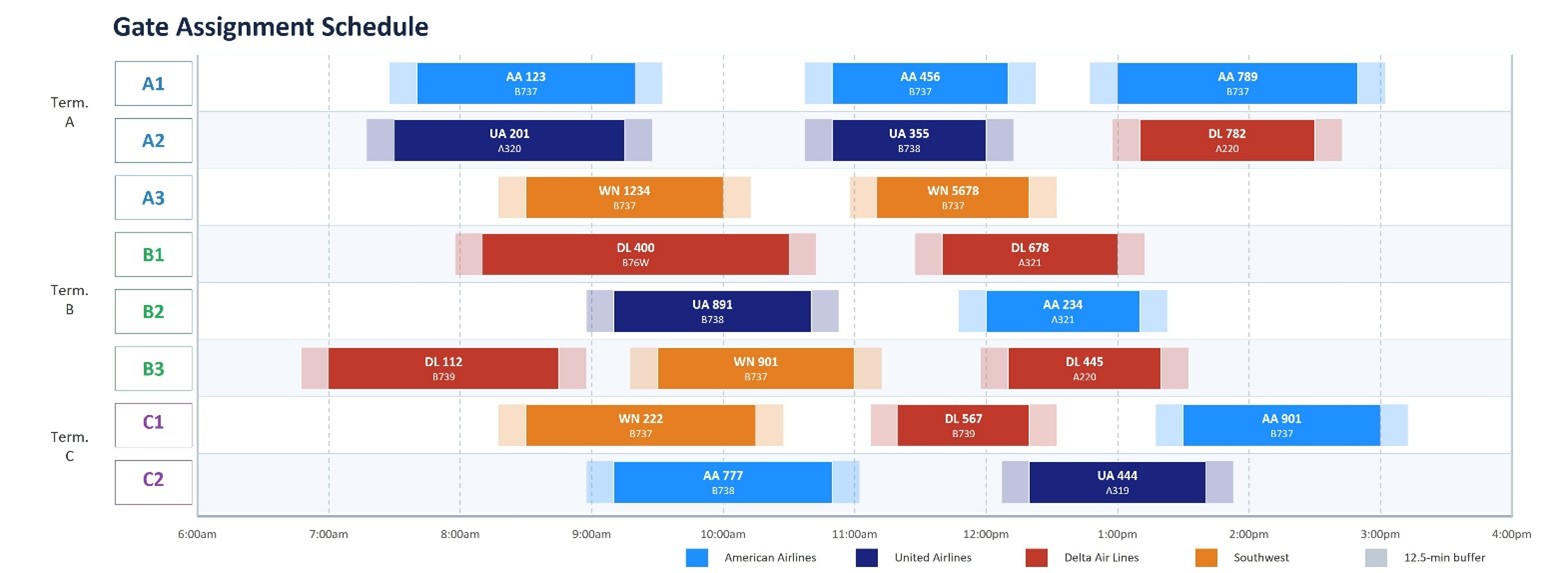 Representative Gantt Chart
The representative Gantt chart — a static, deterministic gate plan with visible utilization variance, long buffers on some gates and tightly stacked turns on others.
With Machine Learning and AI, tools are being adopted that can bring in a host of additional layers for the airport operational managers to make decisions in a live environment.
Real-time predictive re-allocation. Combining live chocks-on/off-block data with predictive turnaround completion models lets the system reassign downstream gates 60–120 minutes ahead of conflict, before the duty manager has to scramble.
ML models trained on historical actual-vs-scheduled distributions assign gates based on probability-weighted on/off-block windows, not single-point estimates.
Visible white space between aircraft turns is insurance against uncertainty. ML can shrink buffers where the data supports it and unlocking 5–10 percent additional stand capacity at the peaks.
Resource optimisation. The real bottleneck is often GSE, pushback tugs, or staff. Co-optimise gate, equipment, and crew allocation as an overall KPI — reducing equipment idle time without compromising service levels.
Predictive AI systems, trained on historical flight performance, real-time weather feeds, passenger flow models, ground service event logs, and stand allocation histories, can model the state of an airport’s operations not just now, but two, four, or six hours from now — to drive pre-emptive decision-making rather than reactive coordination.
Measurable Value
Deployments now in the field — Heathrow, Schiphol, Changi, Frankfurt, and a growing set of US hubs — are generating consistent operational improvements across several categories.
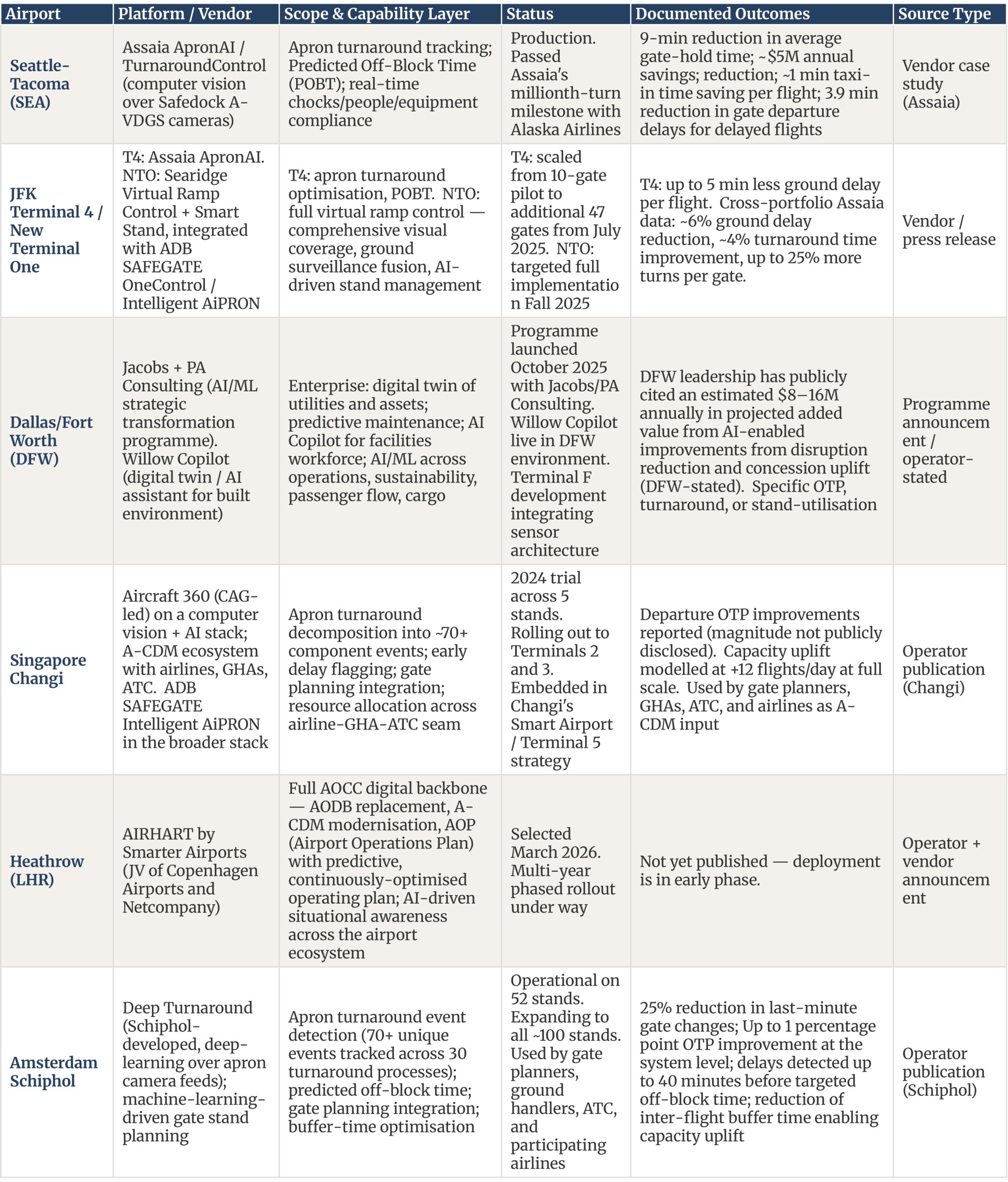
What is clear is that the European hubs and Changi are one step ahead at the AOCC backbone layer; US deployments are concentrated at the apron/turnaround layer. SEA, JFK T4, and CVG (Assaia) and JFK NTO (Searidge) all sit on the same architectural layer. DFW is the closest US analogue to the European AOCC-stack programmes but is earlier in the cycle.
Heathrow’s. AIRHART integrates data across the full airport ecosystem and applies machine learning to generate operational forecasts and decision support in real time. At around 480,000 aircraft movements annually and capacity utilisation exceeding 98 percent, Heathrow is the most demanding test environment in global aviation.
US deployments are catching up. Several major hubs have predictive AOCC programmes in evaluation, pilot, or early deployment, and the integrator-driven cargo hubs — Memphis, Louisville, and Anchorage. The gap is not technology availability. It is the willingness to commit to the multi-stakeholder transformation that extracts the value.
The Business Case for US Airport Operators
The economics are straightforward at the major hubs. At Atlanta Hartsfield-Jackson, where the operation handles roughly 800,000 aircraft movements annually, a one-percent improvement in operational efficiency translates to estimated order-of-magnitude $10–14 million[2] in direct cost and delay-related economic value per year. At Dallas/Fort Worth, with over 700,000 movements, the equivalent figure is $8–12 million. Even at smaller hubs — Seattle, Denver, Charlotte, Minneapolis-St. Paul — the math holds: the upside from a working predictive AOCC is in the high seven figures annually, against an implementation programme that is typically a multi-year, mid-eight-figure investment.
The case is even stronger for airports in active terminal development. Miami International, Nashville, Los Angeles, Pittsburgh, Salt Lake City, and Kansas City all have terminal programmes in flight or recently completed. Each has the opportunity to design predictive operational capability — sensor coverage, data infrastructure, control room layout, stakeholder data sharing — into new facilities at a small fraction of the cost of post-opening retrofit.
Avinia’s View: This Is an Operational Transformation
Airport operators often approach AI in the AOCC as a technology procurement exercise — identify a vendor, run a proof of concept, buy a platform. The results are consistently disappointing. The platform works; the organisation does not change; the outcomes do not materialise.
The harder change is the operating model the technology enables. The shared-data agreements that underpin predictive operations require carriers, ground handlers, and airport authorities to commit to a level of operational transparency that most US stakeholder relationships are not currently structured for.
The airports extracting real value started with the operational use cases — what decisions do we want to improve, by how much, and what would it be worth — and built the data infrastructure, governance frameworks, and change management programmes around those decisions. The AI platform came last, not first.