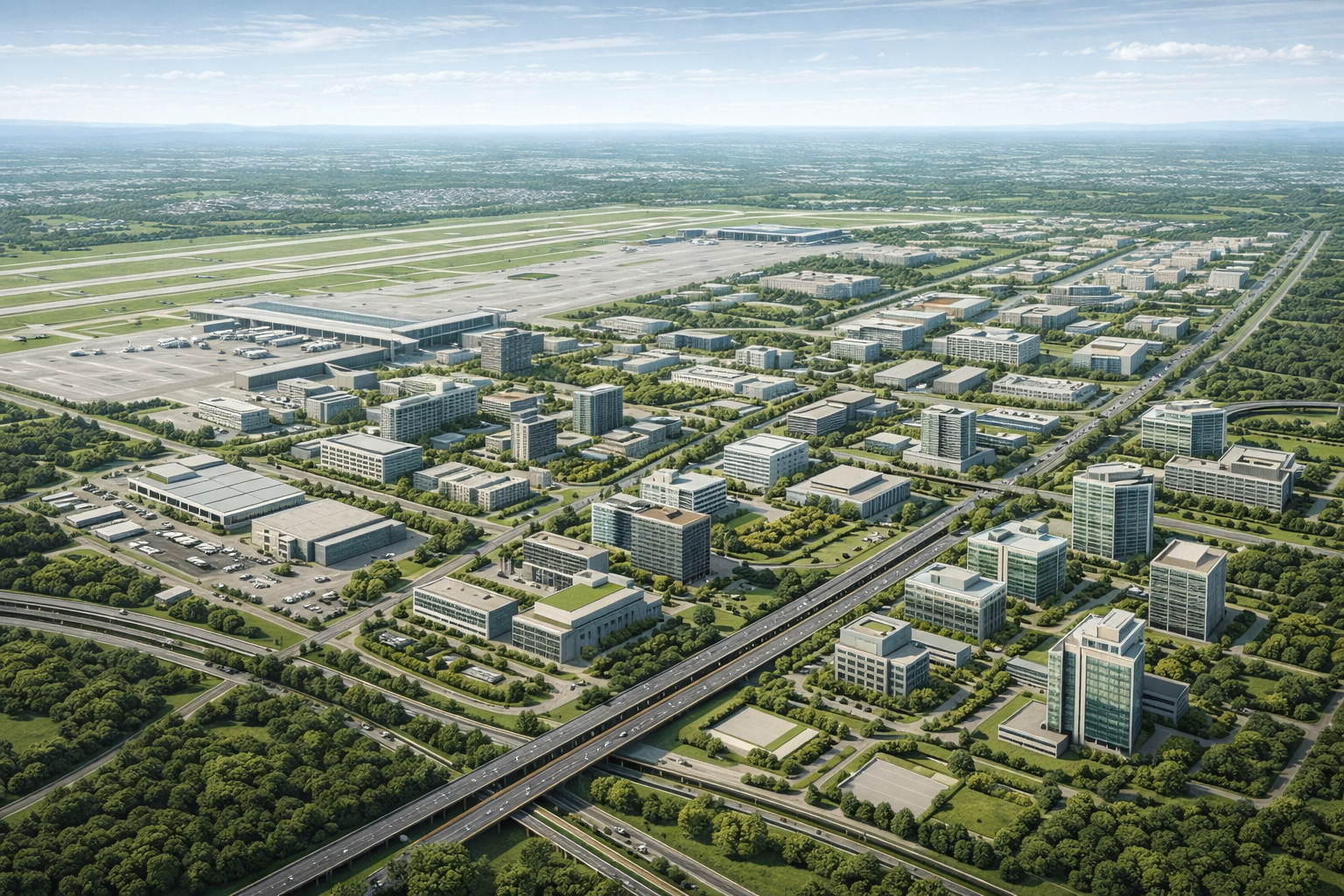
In recent times, airport cities or aerotropolis[1] are increasingly embedded in airport visions, concession documents, and development plans. Yet outcomes vary dramatically. Some evolve into productive economic clusters generating billions in annual value, while others remain fragmented real estate developments disconnected from the very airports they were meant to leverage. The difference lies not in ambition but in execution. Specifically, in understanding that airport cities are fundamentally about time-cost optimization, not traditional location advantages.
In this article we explore how an airport city[2] can be planned successfully by aligning to its tenants’ value proposition.
The Time-Cost Paradigm
Traditional real estate planning measures value in distance—kilometers from the urban core or major infrastructure. But airport city planning demands a different calculus: time and cost of connectivity supersede space and distance. A firm located 30 kilometers from an airport with 10-minute highway access possesses superior competitive positioning to one situated 5 kilometers away with 45-minute congested travel time.
Consider the pharmaceutical supply chain. Kenya’s logistics improvements reduced customs clearance time for air shipments from 2.5 days to 1.8 days resulting in more timely delivery of life-saving HIV/AIDS drugs. For fashion retailers like Zara, supply chains move from concept to store display in weeks, turning time into competitive currency. Similarly for high-value electronics, biomeds, and perishables, air transport provides what economists term “economies of speed”, competitive advantages that emerge from velocity, not scale.
For airport city businesses, a 15-minute accessibility enables just-in-time logistics while maintaining schedule reliability. A manufacturer needing to ship high-value components can move from factory floor to aircraft in under an hour. A consultant can leave the office, clear security, and reach the departure gate within 45 minutes. This rapid, reliable connectivity defines the competitive advantage of an airport city and commands premium pricing.
Delhi Airport city exemplifies this value creation. It has attracted ₹30 billion in investment demonstrating that aerocities generate returns far exceeding traditional real estate when properly executed.
Strategic Tenant Curation
It is imperative that product mix and zoning are planned with time-cost optimization as the primary criterion. Not all businesses benefit equally from airport proximity, and indiscriminate leasing dilutes airport city value proposition.
Premium airport city pricing is justified for high time-sensitivity segments like express logistics and e-commerce fulfillment (Amazon, FedEx, DHL), pharmaceuticals requiring cold chain and rapid delivery, high-value electronics where obsolescence risk demands rapid throughput, fresh produce and perishables where every hour affects quality and price, and advanced manufacturing with global supply chains.
Moderate time-sensitivity tenants like business services with frequent air travel, exhibition and conference centers may value airport proximity but won’t pay the highest premiums. These should occupy secondary rings with good connectivity rather than premium adjacent to airside zones. If an industry doesn’t genuinely benefit from rapid airport access, they’re seeking lower land costs rather than time-cost advantages—and won’t sustain premium rents.
To maximize airport city value, Indian airports must avoid common planning mistakes that undermine the fundamental value proposition
1: Prioritizing Aesthetics Over Functionality
Many airport city plans emphasize architectural grandeur and landscaping at the expense of traffic flow optimization. Beautiful boulevards with traffic circles may be good urban design features but create bottlenecks that undermine time-cost advantages. Function must precede form in aerotropolis planning. Prioritize grade-separated intersections over picturesque roundabouts, fast-moving traffic lanes over wide pedestrian plazas in freight zones.
2: Ignoring Peak-Hour Performance
Infrastructure that works during off-peak hours may fail precisely when businesses need it most. If manufacturing shift changes coincide with airport passenger peaks, congestion costs multiply. Planning must take into account the operating hours of the facilities planned and provide enough capacity in design, along with flexibility to expand.
3: Confusing Proximity with Accessibility
Being “next to the airport” means nothing if travel time is unreliable or routes are congested. Always measure accessibility by actual travel time under realistic conditions. Plan surface access infrastructure accordingly, prioritizing reliability over just proximity.
4: Not Planning for Multi-Modal Integration
Transfers between modes should take less than 5 minutes with clear wayfinding. Paris CDG, Amsterdam Schiphol, and Frankfurt demonstrate how proper integration multiplies the value of each individual mode. Traffic management systems, grade separations, and modal integration are expensive but they create defensible competitive advantages.
Case Study: Amsterdam Airport Schiphol
Amsterdam Airport Schiphol stands as a compelling case study in how strategic planning can transform an airport into a powerful economic development engine.
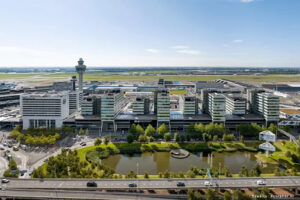
Firstly, the creation of specialized development entities like Schiphol Real Estate (SRE), and public-private partnerships through Schiphol Area Development Company (SADC)[3] enabled coordinated action that would be nearly impossible with fragmented governance. This structural innovation may be as important as any physical infrastructure investment.
The airport functions as a truly intermodal hub. Nederlandse Spoorwegen operates high-frequency rail services connecting the airport to Rotterdam, The Hague, Amsterdam, and international destinations via high-speed rail. High-speed rail integration is particularly important for European contexts. It also has direct access to major European highways enabling efficient road freight distribution. This multimodal integration creates powerful network effects. A business executive can fly from Singapore, clear customs, reach a meeting in central Amsterdam within 30 minutes, and return to the airport for an evening flight to New York, all without needing a rental car. Similarly, high-value air cargo can transfer seamlessly to road or rail distribution networks, minimizing handling time and maintaining cold-chain integrity for pharmaceuticals and perishables.
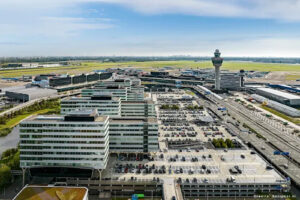
The airport city, Schiphol Central Business District (CBD) has passenger terminals, retail galleries, office buildings, hotels, conference facilities, dining establishments and entertainment venues. This 2-million-square-meter mixed-use core houses corporate headquarters of major multinationals including Microsoft Europe, Citibank, and Samsung, alongside 578 different businesses ranging from Fortune 500 companies to innovative startups.
The Strategic Imperative
In an era where business competitiveness depends on supply chain velocity, manufacturing flexibility, and rapid market response, accessibility has replaced location as the paramount consideration. An airport city with 15-minute terminal access and 95% travel time reliability can charge premium rents and attract premier tenants.
For airport operators developing India’s ₹15-18 lakh crore airport city opportunity, the prescription is clear: map time-cost accessibility rigorously, invest in infrastructure to minimize temporal friction, zone by connectivity rather than proximity, and curate tenants for whom speed creates measurable value. When executed properly, this approach transforms landside holdings from static real estate into dynamic platforms for the velocity-driven economy.