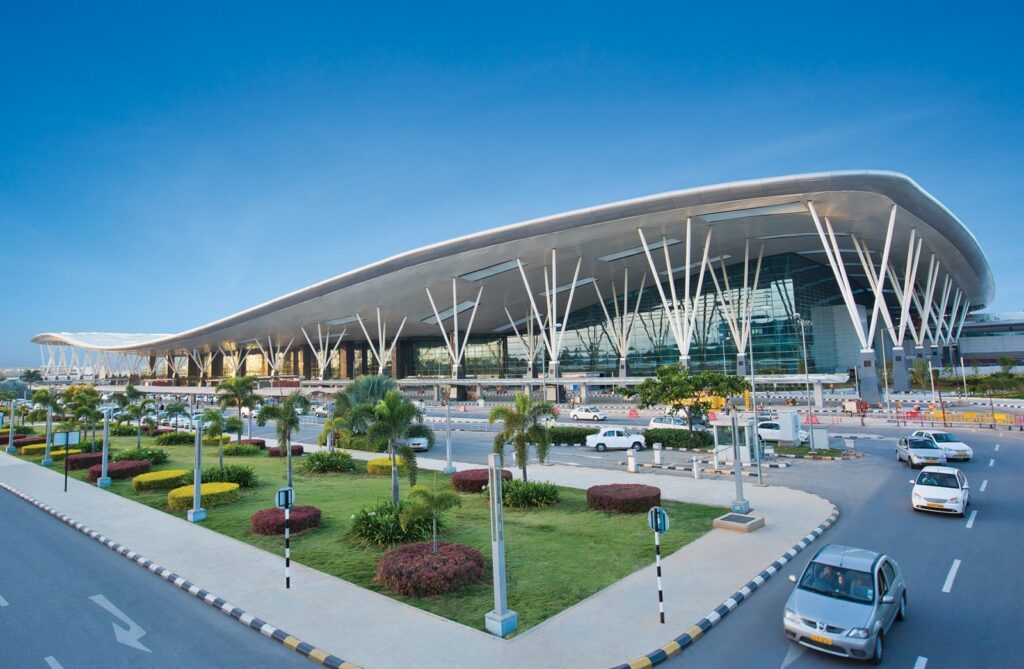
The terminal kerbside is the first touchpoint for passengers at any airport. Efficient design not only shapes the passenger journey but also has a direct impact on safety, operations, and customer experience. With growing volumes, multiple modes of access, and changing technology, Bengaluru International Airport Limited (BIAL) prioritized the need to redesign and optimize the Terminal 1 kerbside operation to ensure smooth flows by eliminating some of the critical pain points.
Avinia was engaged to review and redesign the Terminal 1 kerbside, with the objective of enhancing space utilization, streamlining passenger and traffic flows, and creating a more resilient operational environment.
“Avinia partnered with us on the recent T1 kerbside redesign project where they brought in solutions that were practical, cost effective and timely. We had a complex problem that needed a quick fix without compromising on passenger experience. The Avinia team brings the right blend of professionalism, technical knowledge and delivery excellence, while quickly grasping all stakeholder needs and translating them into solutions that accelerated decision-making. We are excited to implement this solution.”
Suman Ramasundaram, Associate Vice-President & Head of Master Planning, Bangalore International Airport Limited
Understanding the challenge
Terminal 1, originally designed to function as an integrated terminal is now undergoing refurbishment to function as a domestic only terminal and enhance its capacity to handle 35 million passengers per annum (MPPA).
BLR was recognized as the ‘Best Airport for Arrivals Globally’ in 2024. This benchmark is a strong recognition of the passenger convenience that BIAL has successfully delivered over the years. With growing demand, the need to maintain the high service levels and eliminate traffic management and congestion issues at the kerb, drove the need for the engagement.
Avinia’s airport planning and design team conducted a comprehensive review of the existing layout and worked closely with BIAL’s stakeholders to align diverse requirements—delivering a design that meets current operational needs while remaining adaptable for future growth.
“For a project like this, stakeholder consensus was just as critical as the design itself. By bringing together inputs from operations, commercial, and security teams, and applying design thinking principles, we were able to co-create a solution that everyone could stand behind”- Lekhya Karyampudi, Project Lead, Avinia
Designing for efficiency and passenger experience
At BIAL, passenger experience is a guiding principle. The redesigning of Terminal 1 kerbside layout was shaped around this philosophy. We worked with BIAL’s team to test and validate multiple layout options. Key features of the finalized plan are:
- Optimised space allocation between different vehicle types to reduce congestion during peak hours
- Improved queuing and pick-up kerbs design to enhance passenger safety and comfort
- Passenger-first features that simplify journeys and reduce stress at drop-off and pick-up points were identified and located on the terminal forecourt
- Flexible layouts that can accommodate future growth strategies
- Operational efficiency gains through better flow management and integration with terminal processes
The design recommendations were underpinned by data-led analysis and developed in consultation with stakeholders across the airport ecosystem, ensuring alignment with BIAL’s long-term vision.
Unlocking long-term value.
A key aspect of the exercise was also to articulate and align the current requirements with the future growth scenarios. We developed strategic decision pathways and working backwards, we shaped a redesigned layout that is both flexible and adaptable. This approach ensures today’s investments will continue to create long-term value and integrate seamlessly with future parking and pick-up developments, rather than becoming obsolete.