For decades the Boeing 757, developed as a replacement for the Boeing 727, dominated the transatlantic niche. Its range, short-field performance, and 200-seat capacity made it the perfect workhorse for airlines. Over time, however, higher maintenance costs and lower fuel efficiency compared with the new kids on the block have reduced its attractiveness for long-haul routes.
The 757-200 has served exceptionally well on longer transatlantic services and is widely used by United Airlines and Delta Airlines – over 107, 757-200 aircraft were active as of February 2026. Much to the dismay of the avgeeks and aviation enthusiasts, 757-200 production ended in 2004 due to a sharp drop in orders.
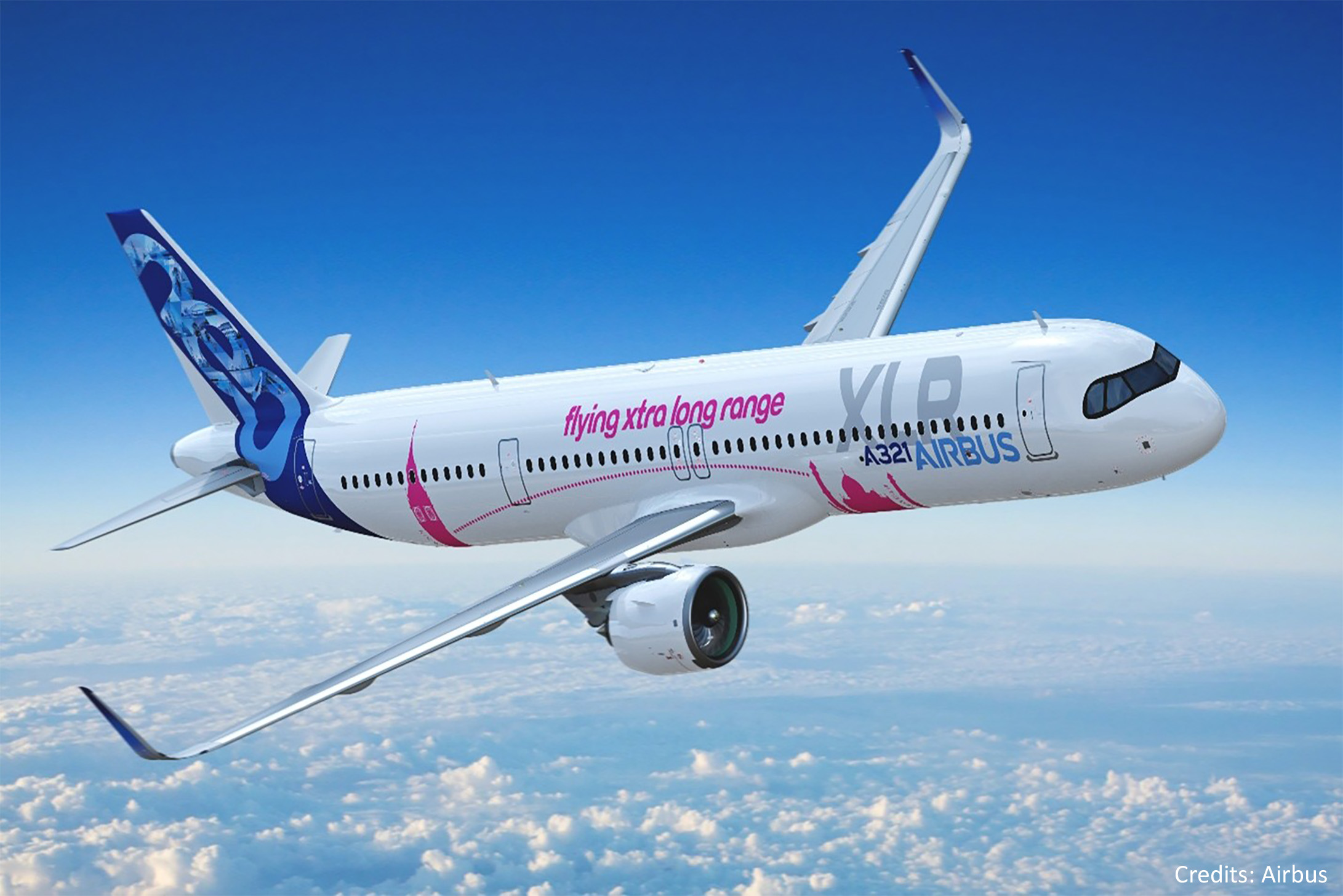
Can the Airbus A321XLR serve as a practical replacement for the Boeing 757-200 on thin and long routes? We look at the economics through the lens of a case study for the Newark (EWR) – Edinburgh (EDI) route.
While United Airlines is one of the legacy carriers that is betting on the A321XLR, Delta is yet to jump on the A321XLR bandwagon. United plans to replace most of its 757-200 fleet with the 50 A321XLR that has been ordered in December 2019 primarily to serve medium to long-haul transatlantic and transcontinental routes.
United operates 36 Boeing 757-200, with an average age of 20 years, on transcontinental routes and on transatlantic services from key U.S. hubs, including Newark/New York and Washington, DC. It expects to take delivery of its first A321XLR in mid-2026, with entry into service planned around summer 2026.
United has selected a three-class cabin layout for the A321XLR. This includes 20 Polaris business class seats, 12 Premium Plus seats, 36 Economy Plus seats, and 82 standard economy seats, for a total of 150 seats. Compared with the 757-200, this configuration prioritizes premium seating and higher-yield passengers.
So, it’s the economics and the range that are both compelling for the A321XLR compared to the 757-200. Let’s discuss some specifics.
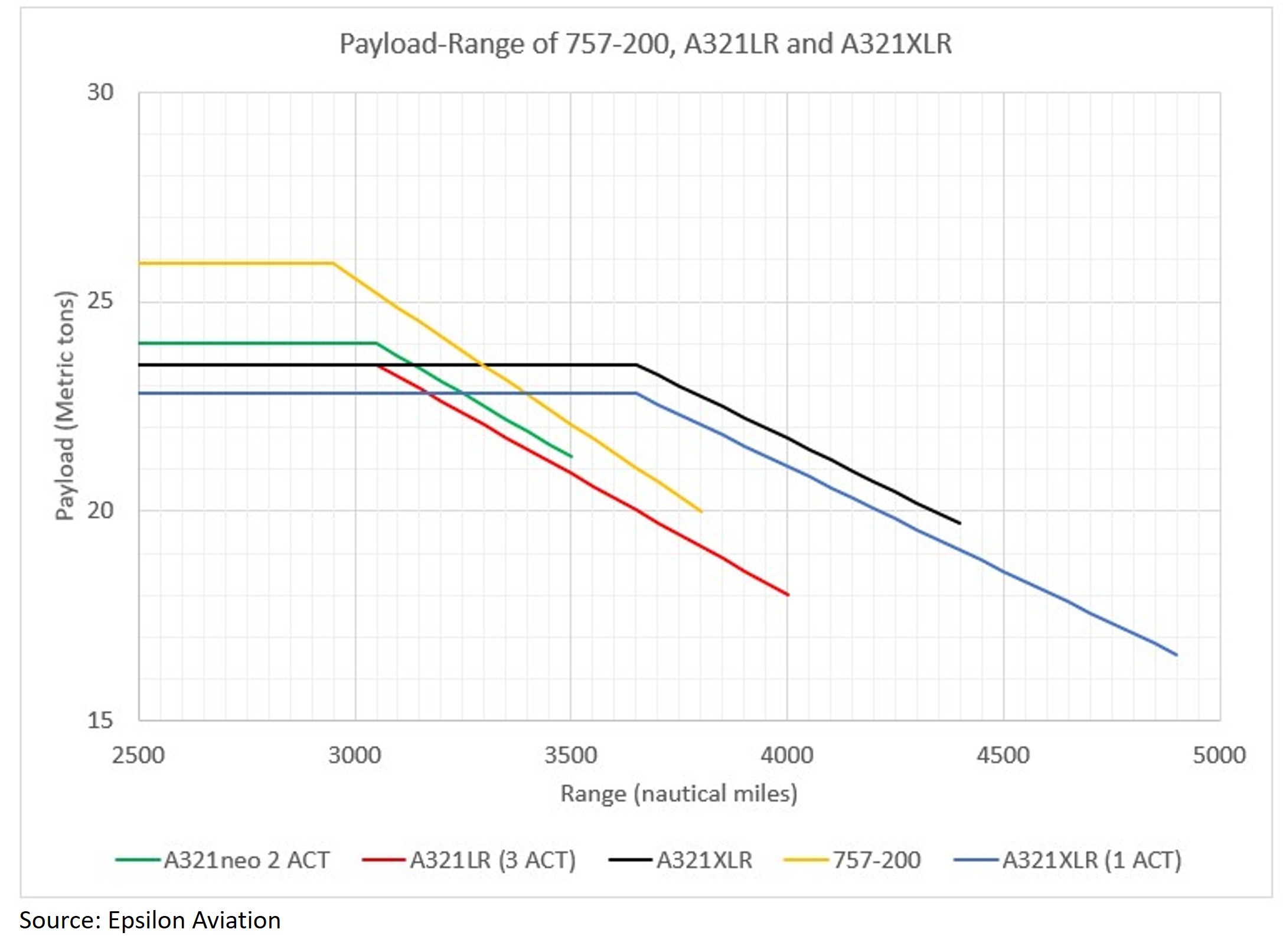
Compared with the 757-200, the A321XLR provides an additional 700 nautical miles with Maximum Take-off Weight (MTOW). With lower payloads, the range of the A321XLR can extend to over 4,000 nautical miles. That is a substantial upside to the range for the legacy carriers with fewer seats (in a 3-class configuration). The range also comes at a lower cost per seat mile and lower emissions.
New non-stop service from Boston (BOS) to Lisbon (LIS) or Washington Dulles (IAD) to Dublin (DUB) can be economically viable and highly profitable. With the current fares on transatlantic routes, the economics are tilted very heavily towards the airline operator.
United is currently operating the Newark (EWR) – Edinburgh (EDI) route using the current fleet of 757-200. The route distance is approximately 5,258 kilometers (2,839 nautical miles) with a block time of 7 hours.
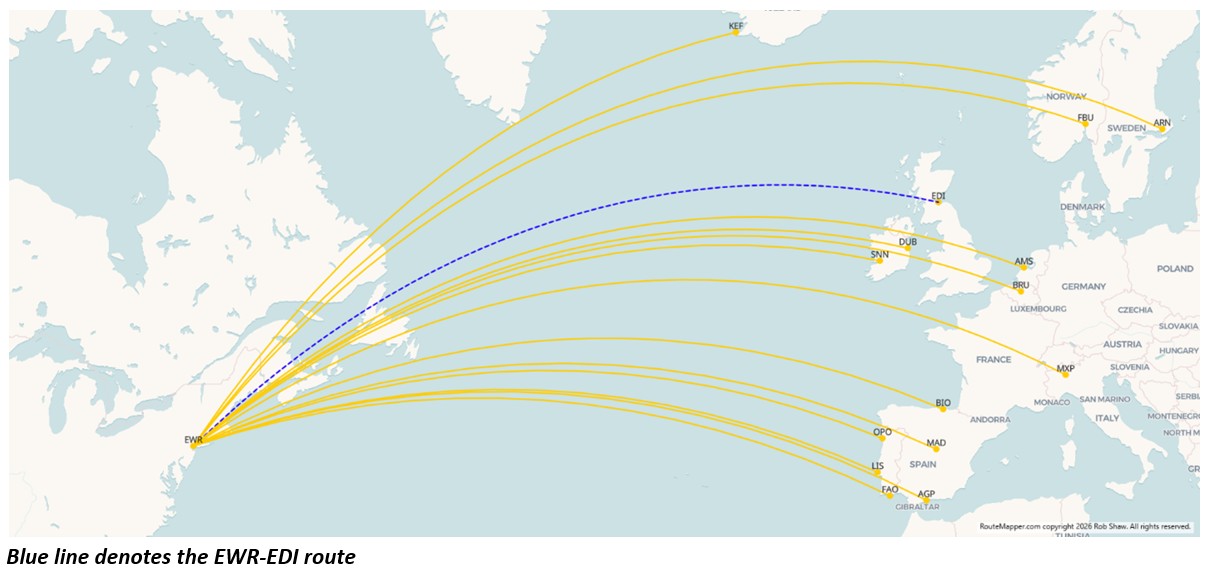
The map illustrates destinations historically served from Newark using the Boeing 757-200.
EWR – EDI Economics

The direct operating cost on A321XLR is assessed to be 30% lower on the EWR-EDI route driven by significant reduction in the fuel cost. The hourly cost is also cheaper by 20% due to lower maintenance costs (based on a 100-hour monthly cycle). The total trip (excluding indirect costs) works out to be about 30% lower. The A321XLR benefits from lower fuel burn, lower maintenance cost per hour, and a lower operating weight, which cumulatively reduces total trip cost.
On the transatlantic route, profitability is driven less by achieving a specific load factor and more by the quality and mix of revenue generated per flight. Average fares on this market are relatively high compared with high-density routes, reflecting limited nonstop competition, long stage length, and a higher share of premium demand. The revenue structure shows a clear difference between the two aircraft. On average fares for Newark (EWR) – Edinburgh (EDI) (from Expedia.com), Business Class and Premium Plus together can contribute roughly 40% of total passenger revenue (20 seats Business & 12 seats Premium Plus), compared to about 21% premium cabin revenue (from business class 16 seats) on 757-200.
And the product mix dovetails with the growing trend for premium service. United is betting on high yield transatlantic travel. Premium cabin revenue grew by 12% year-over-year in 2025 at a systemwide level, with premium revenue per seat outperforming the main cabin by approximately 10 percentage points, highlighting the airline’s strategic focus on premium services.
Conclusion:
The analysis for the specific EWR-EDI route and can be generalized for other medium to long haul routes shows that the economics of shifting to the A321XLR from the ageing 757-200 is a no brainer. The Boeing 757 served as a workhorse for long, thin routes, offering higher capacity than the 737 and enabling efficient transatlantic and extended-range narrow-body operations. However, the aircraft has now largely outlived its operational and economic relevance.
The A321XLR provides a more efficient platform to replace an aging fleet while maintaining long-haul narrow-body capability. Lower operating costs, reduced exposure to demand variability, and greater flexibility in capacity deployment allow United (and other US carriers who have ordered the A321XLR) to sustain existing routes and selectively expand its network with lower operating risk.