Five Years of Pilots, No Playbook
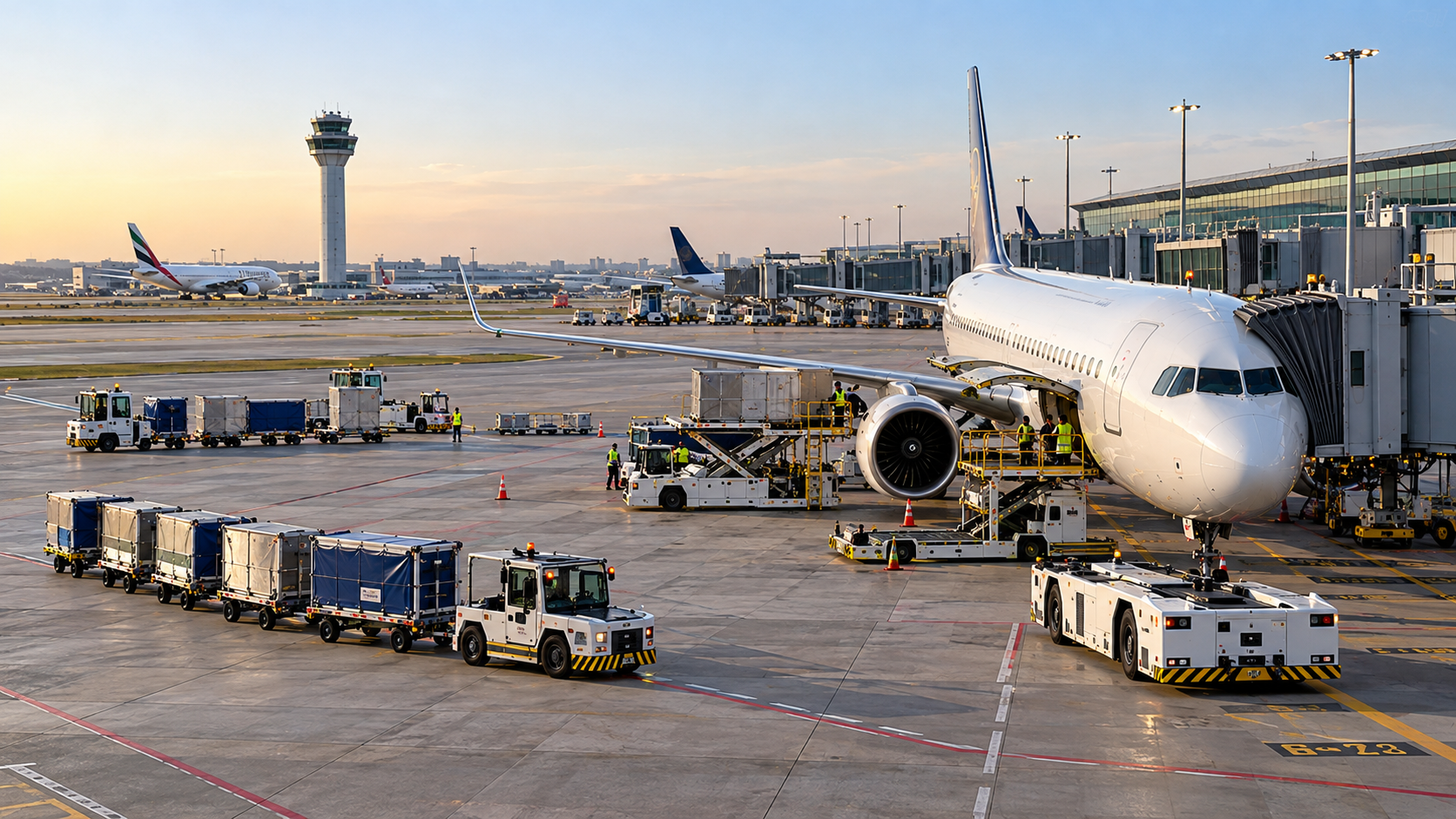
At Dallas Fort Worth (DFW), an electric tug with an EasyMile automated driving system moves cargo between warehouses on the West Cargo ramp, alongside human-driven vehicles. At Cincinnati/Northern Kentucky (CVG), a retrofitted ThorDrive tractor tows baggage through areas shared with conventional GSE.
Outside the U.S., Oslo Gardermoen and Fagernes have trailed autonomous snow ploughs, Edmonton perimeter patrols, Gatwick airside staff shuttles and Schiphol baggage tractors.
Technology works in controlled conditions. What none of these programmes produced is a repeatable path.
ACRP Research Report 283 says it plainly: airside AGV implementation is “siloed across airport environments and use cases.” Every airport writes its own safety case, negotiates its own insurance, invents its own KPIs and convinces its own legal team from scratch.
That is an industry stuck in pilot mode. And it is expensive. Executive attention, legal capacity and operational goodwill get spent again at every airport instead of compounding across the sector.
The report was prepared by EY-Parthenon, AVP RTS and Futron Aviation under ACRP Project 10-32 and sponsored by the FAA. Every airport executive with an innovation budget should read it. It quietly changes who is responsible for making autonomy safe.
The Framework in Brief
Six steps. The first five come before any vehicle moves.
Characterise the airport. Traffic complexity; collision and incursion hot spots; geography and weather; towered or non-towered; signs, markings and lighting; movement-area geometry; digital connectivity. A busy, humid coastal hub and a quiet regional field are different problems. Match the use case to the airport.
Write a CONOPS. Capability needs, current state, operational and technical requirements, airport integration, stakeholder engagement, impacts and next steps. A preliminary CONOPS is fine. It matures with the evidence.
Run safety risk management. Use the five-step process in FAA Advisory Circular 150/5200-37A: describe the system, identify hazards, analyse risk, assess risk, mitigate risk.
Agree performance metrics and a data collection plan.
Train people. Classroom and hands-on.
Kick off operations, as a trial that builds the safety case, not as a production service.
None of this will surprise an airport safety manager. What matters is that a federally sponsored research body has now written it down as the expected standard of care. Insurers, boards and, eventually, courts could use it to judge an airport that skipped steps.
The Regulatory Vacuum Is the Real Story
The FAA has not approved AGV for use on airports. It is still researching the technology to set safety standards. The report notes that conformance standards and acceptable performance metrics for AGV “are not yet established in law.” Even the safety management system (SMS) advisory circular was not written with autonomous vehicles in mind.
So, the airport operator is the regulator of its own apron. It decides which vehicles operate, where, under what conditions, with what insurance and on what evidence.
The report’s answer is to borrow from adjacent industries: SAE J3016, UL 4600, ISO 26262, ISO 21448, ISO/SAE 21434 and BSI PAS 1883 for operational design domain (ODD) taxonomy. The playbook adds ISO 3691-4 for driverless industrial trucks, arguably the closest analogue to a baggage tractor.
Correct, but not enough. These standards were written for highways and warehouses. The apron has hazards none of them anticipate: wingtips and engines over service roads, jet blast, aircraft that always have right of way, FOD, and the outsized cost of even minor contact with a widebody. Adopt road standards wholesale and you under-specify the risks that matter most.
CVG Shows What Airport-Led Governance Looks Like
CVG has the clearest model. Section 507 of its Rules and Regulations, revised in February 2024 and reproduced in full in the report, allows autonomous vehicles on airport roadways, inside terminals and in the AOA, subject to twelve conditions.
Among them: prior written notice of the use and geography, a CEO-issued permit with a release and indemnification, a permit decal, approved locations only, crash-avoidance and automated emergency braking, compliance with airport standards, insurance set by the risk manager, and revocation by the CEO at any time.
The design is smart. A deliberately broad ordinance enables activity and keeps discretion. The permit adds the specifics, case by case. The report endorses exactly this: start broad, add specific rules as new use cases emerge. It is a minimum viable product for regulation, and it let CVG host multiple trials without rewriting its rulebook.
Most U.S. airports have nothing like it. Their rules assume a licensed human driver behind every wheel. Until that changes, every AGV proposal is an exception. Where airports have written rules for autonomous vehicles, they have largely done so landside, for robotaxi pick-ups at the kerb, as Phoenix Sky Harbor did with Waymo. Those arrangements govern trip fees and staging areas, not operations alongside aircraft.
Data Rights Are the Hidden Strategic Asset
The framework lists more than 20 KPIs: time in autonomous mode, zero-disengagement runs, manual interventions, route deviations, safety-related stops, OSHA-recordable incidents. Behind them sits the raw data: vehicle motion and jerk, object detection and response times, safety-driver interruptions, system health, and high-frequency event records such as the five seconds before an incident.
This is not performance monitoring. It is the evidence for every next decision: removing the safety driver, expanding the ODD, pricing insurance, proving the business case.
At both DFW and CVG, the technology partner owns and operates the vehicle. Unless the airport has negotiated access, the data that justifies the next phase sits on the vendor’s servers.
Our position is simple. AGV operating data is airport infrastructure data. Write it into every permit and partnership agreement as a condition of access to the airfield. The airport that owns a multi-year, multi-vendor dataset will set the terms of the market. The one that does not will be negotiating against its own tenants’ evidence.
The Economic Prize Is Fleet Utilisation
Why go to all this trouble? Gatwick’s case study answers it in one number. Its 300 airside vehicles are stationary 90% of the time. That is roughly 10% utilisation.
Lift that to 25% with an automated, dispatchable pool and the same work needs about 40% of the fleet, around 120 vehicles. Every vehicle removed cuts apron congestion, parking demand, charging load and collision exposure. It also frees apron space, which at a constrained hub is usually the scarcest asset of all.
That prize only comes at scale, and scale only comes through standardisation. One autonomous tug on a fixed cargo route proves the technology. A dispatchable, multi-vendor, data-connected fleet under a common airport rulebook changes the economics.
Avinia's View
Stop treating airside autonomy as an innovation-office experiment. It is an operating model decision, and governance comes first. Four actions for the next 12 months.
First, write the ordinance. Amend airport rules and regulations on the CVG model: broad enabling language, CEO discretion, a permit regime.
Second, build the safety case template. Layer apron-specific hazards (aircraft envelopes, jet blast, right of way, FOD) on top of the borrowed road and robotics standards.
Third, own the data. Make data access and a common KPI set mandatory in every AGV permit. Every trial should build an airport-owned evidence base, not a vendor’s.
Fourth, plan the infrastructure. Put AGV requirements into the next master plan update and apron design standards: charging, staging areas, connectivity, geofence-compatible markings. Be ready when the technology and the FAA are.
The leaders will not be the airports with the biggest innovation budgets. They will be the ones that accept that, without federal rules, the airport is the regulator, and act like it.
Source: Avinia analysis of ACRP Research Report 283: Airside Automated Ground Vehicle Systems at U.S. Airports: Adoption Framework (National Academies Press, 2026) — https://doi.org/10.17226/29505