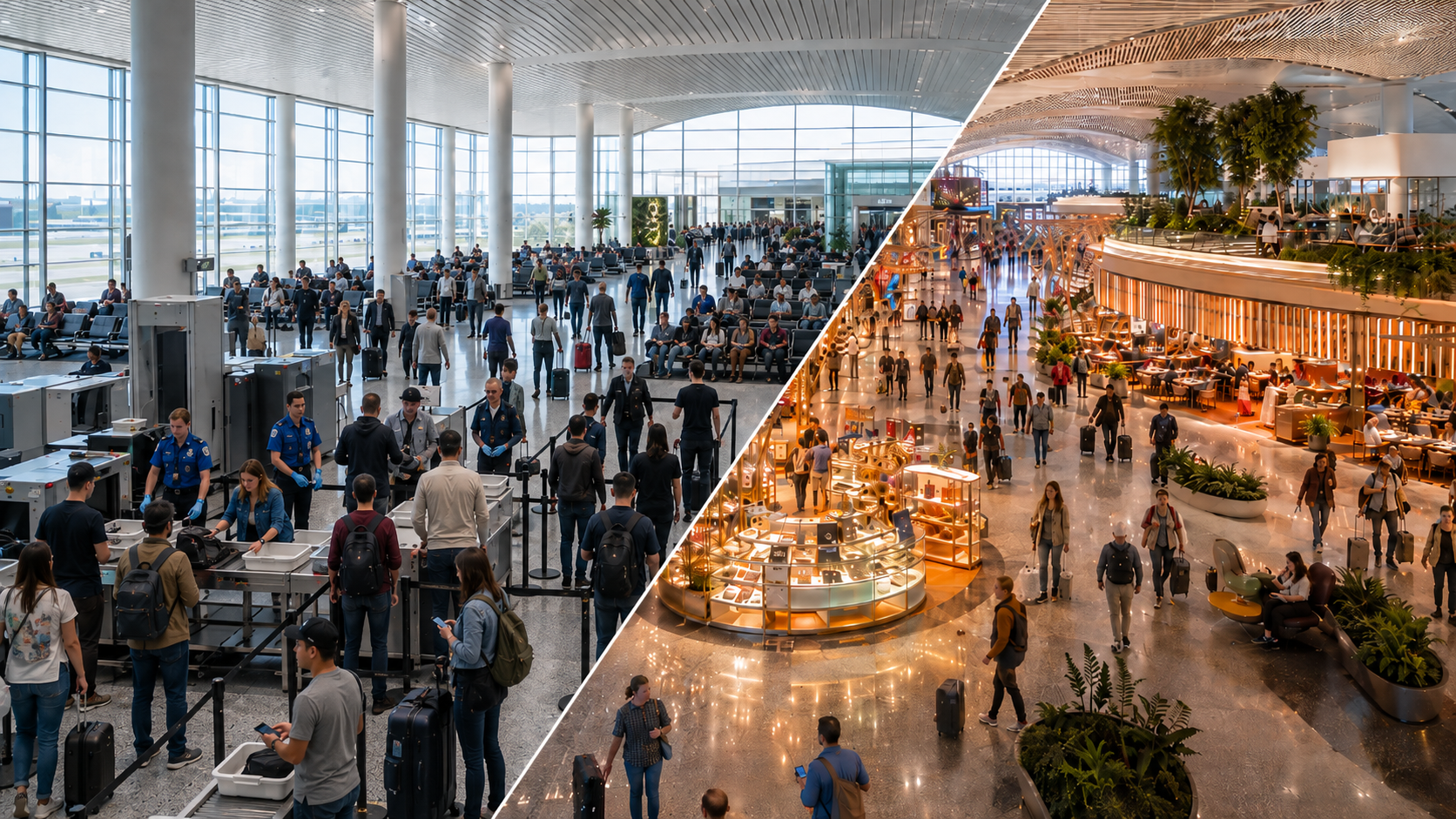
Why the terminals converting design into commercial performance treat legibility and retail as one problem, not two.
US airport terminal construction will reach a record $28 billion in 2026, and roughly three-quarters of the projects starting this year are modernisation and renovation rather than new builds. Most of it is being spent precisely where wayfinding and commercial planning collide.
These two disciplines are usually procured separately and measured against contradictory objectives. Wayfinding consultants are asked to minimise the time and cognitive effort between entry and gate. Commercial teams are asked to maximise dwell and spend. Read literally, one wants passengers to move faster and the other wants them to move slower, and the standard resolution is a negotiated compromise — a signage scheme that is deliberately a little less direct, a retail frontage that is deliberately a little more obstructive.
What Dwell Time Is Actually Worth
Start with the commercial arithmetic, because it is more precise than the sector usually admits. Non-aeronautical revenue now accounts for roughly 37 to 40 percent of total airport revenues globally, and retail concessions represent between 20 and 26 percent of that non-aeronautical line. Global passenger spending averages around $5.90 per head across duty-free and retail, with the largest US hubs — Atlanta, Dallas/Fort Worth, Los Angeles — clearing $10. The category is worth roughly $115 billion worldwide in 2026, and ACI World’s most recent economics reporting still puts non-aeronautical revenue around nine percent below its pre-pandemic level. There is real recovery headroom here, and airports are pursuing it through design.
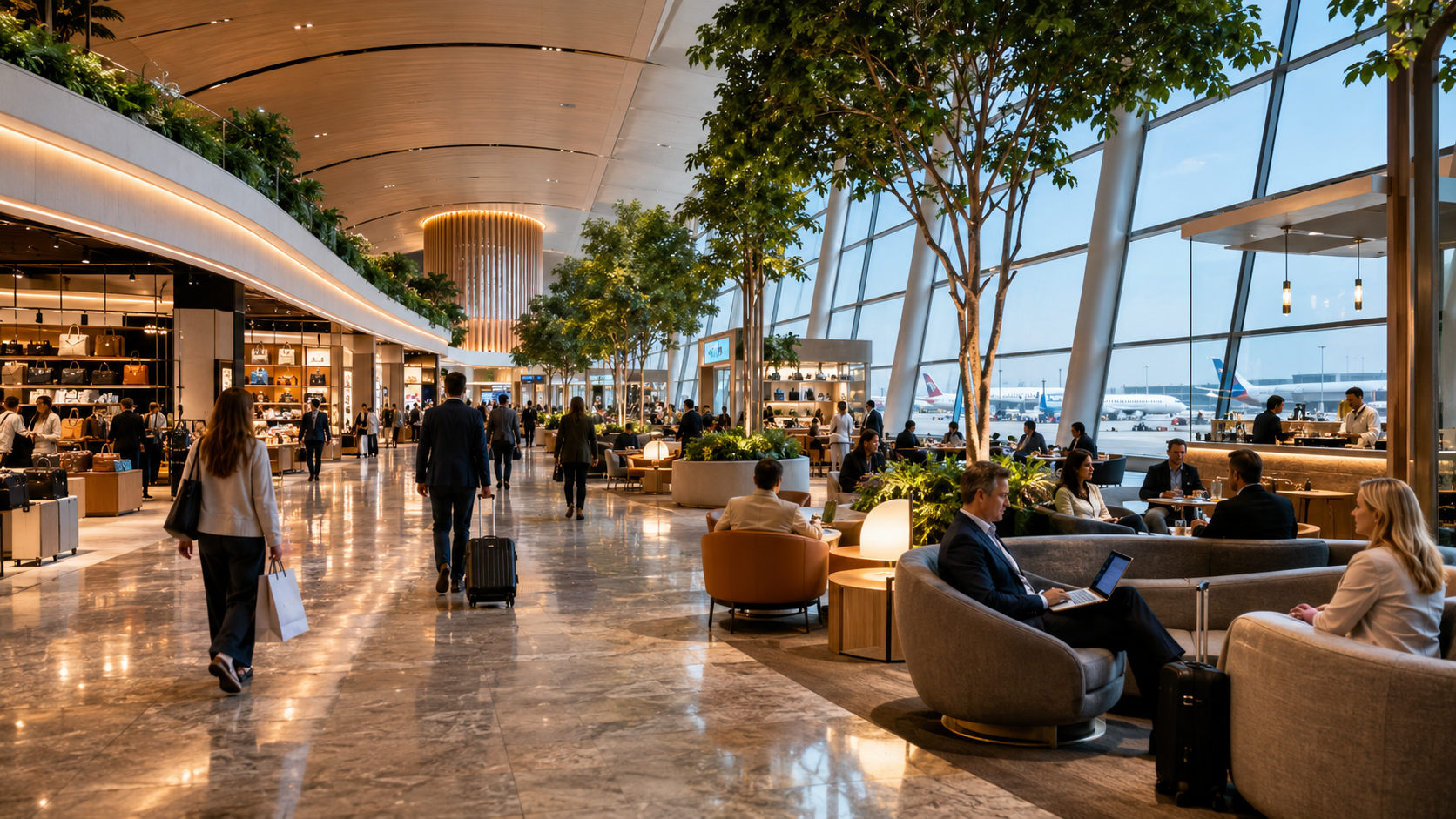
The elasticity is well established. A ten percent increase in passenger dwell time translates to roughly a five percent increase in non-aeronautical revenue overall, disaggregating to about eight percent for food and beverage and six percent for retail. Average dwell in retail areas sits at around 13 minutes. At the same time, the relationship between retail dwell and upstream queuing is negative and exponential: friction at check-in and security does not simply shift spending later in the journey, it destroys it. A passenger who has spent twenty-five unpredictable minutes in a security queue does not arrive at the concession level with twenty-five minutes of pent-up shopping demand. They arrive stressed, behind their own mental schedule, and unwilling to commit to a transaction that might cost them their gate. Dwell time only converts to revenue when the passenger believes they have it.
Certainty Is What Sells
This is the mechanism that resolves the apparent conflict between the two disciplines. A passenger who cannot see where the gates are will walk toward them anyway, quickly, and will not stop. A passenger who can see the gate corridor from the concession level, and knows it is four minutes away, will sit down.
The design implication is that legibility is not a constraint on retail but a precondition for it. The old industry instinct — borrowed from shopping-mall practice — held that mild disorientation encourages browsing. In a terminal that logic inverts, because the cost of getting lost is not an extra lap of the mall, it is a missed flight. Terminals that obscure the route to the gate suppress spending among exactly the passengers with the most time and the most money to spend.
Sight Lines Are the Asset Both Disciplines Share
Pittsburgh International’s new landside terminal, opened in November 2025, is the clearest recent US demonstration of the principle. The terminal design is organised around a single main hall with uninterrupted sight lines to ticketing and to the gate corridor. Wayfinding is carried by architecture first and signage second: black-and-yellow pylons at the entries, high-contrast displays, raised floor textures marking decision points, and audio prompts synchronised to digital screens for passengers with low vision. A passenger entering the building can see, without reading anything, where the two things they care about are located.
That legibility is also what makes the commercial floor work. Concessions in a terminal with clear sight lines can be placed in the passenger’s field of view without being placed in their path.
Where the Two Disciplines Still Genuinely Conflict
Not every tension dissolves. The walk-through duty-free format is the honest example. It delivers one hundred percent of departing passengers into the retail offer, which is why it remains the single most commercially effective configuration in travel retail, and why around 60 percent of travellers — per Airport Dimensions research — say they want to see more of it. It is also, by construction, a forced-path design: the opposite of an open layout with free sight lines to the gate.
The resolution is sequencing rather than principle. The walk-through works where it sits immediately after the recomposure zone, at the point in the journey where the passenger has just cleared their highest-anxiety moment and has not yet begun counting down to boarding. It fails when deployed deeper into the airside journey, closer to the gates, where the same forced path reads as an obstacle.
The Digital Layer Is an Amplifier, Not a Substitute
Digital wayfinding is now a standard line item, and the direction of travel is clear. Philadelphia refreshed its kiosk-based wayfinding platform in May 2026, combining live flight data, optimal-path routing, and advertising inventory in a single system; the broader market is consolidating around AI routing engines and augmented-reality terminal guidance. The commercial logic is attractive, because a routing system that knows where a passenger is going can also know what is on the way.
SITA’s 2025 passenger research puts airline app usage at 23 percent of passengers, up seven points in five years. It is still a minority of travellers. A terminal that is only navigable with a phone is not navigable. Second, digital wayfinding optimises for the fastest route by default, which is not the route a commercial team would choose. Airports deploying these systems need an explicit editorial policy on routing, because a platform that quietly routes passengers past paying tenants while presenting itself as neutral navigation is a trust problem waiting to surface.
Avinia’s View
- Brief wayfinding and commercial planning as a single workstream, under a single accountable lead, before concept design is fixed. The decisions that determine both outcomes — such as hall geometry, ceiling height, the position of vertical circulation, and the sight line from the recomposure zone to the gate corridor — are made in the first ten percent of the design programme and cannot be recovered later with signage or fit-out. Airports that procure wayfinding as a downstream signage package are buying mitigation, not performance.
- Model discretionary dwell, not total dwell, in the commercial business case. Discretionary dwell is the total dwell less queuing, less walking distance, and less the schedule buffer passengers hold in reserve — and is a better predictor of spend. Treat upstream processing as a commercial investment. Checkpoint throughput and queue predictability are usually justified on level-of-service and staffing grounds alone. Given the exponential relationship between upstream queuing and downstream retail conversion, they belong in the commercial case as well. In many existing terminals the cheapest way to raise concession revenue is not a retail refresh but redesigning a security checkpoint that runs to a predictable time.
Conclusion
The terminals that outperform commercially in this renovation cycle will not be the ones with the densest retail frontage or the most sophisticated signage system. They will be the ones where a passenger, thirty seconds after entering the building, knows exactly where they are going and how long it will take — and therefore feels free to do something else first. Legibility is not the price airports pay for commercial performance. It is how they buy it.
Source: Draft — Avinia Aviation Consultancy