The National Civil Aviation Policy (NCAP) 2016 completed a decade last month. India’s operational airport count has grown from 74 in 2014 to 163 today. UDAN, the policy’s signature regional connectivity scheme, has operationalised 679 routes across 95 aerodromes and carried 1.68 crore passengers. In March 2026, the Cabinet extended that commitment for another decade, approving the Modified UDAN scheme with an outlay of INR 28,840 crore (~US$3 billion) through FY2036 — INR 12,159 crore (~US$1.3 billion) of it earmarked to develop 100 airports from existing unserved airstrips in partnership with state governments, and a further INR 3,661 crore (~US$380 million) for 200 helipads over 8 years. The scheme was formally launched on 4 July 2026.
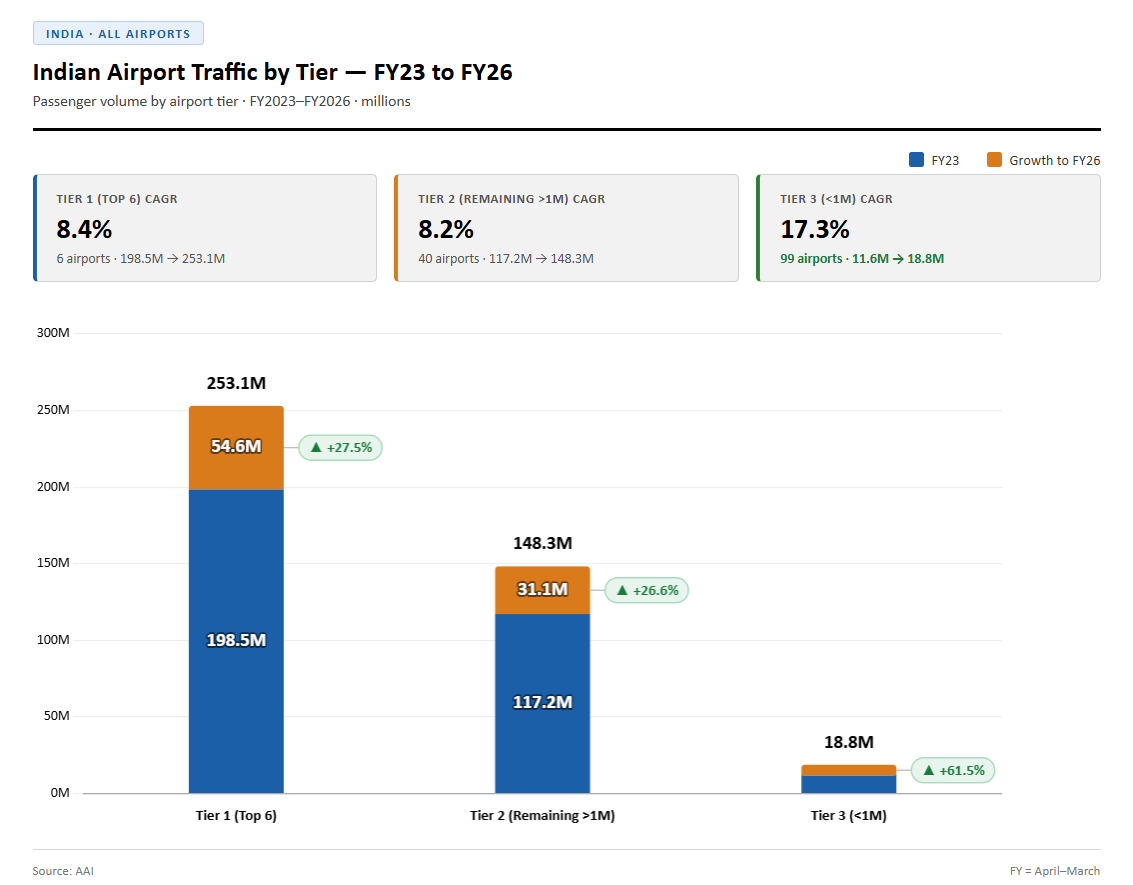
Yet FY2026 offered a timely dose of realism. Domestic passenger traffic grew just 1.4 percent to roughly 339.5 million as elevated ATF prices, a weaker rupee, and geopolitical disruptions in West Asian airspace added operational uncertainty, particularly for international services. Beneath the muted aggregate, however, the structural story holds: Tier-2 and Tier-3 airports continue to outgrow the metros, and the capital is arriving to match.
AAI alone has stated a spend of INR 9,000–10,000 crore1 (~US$1 billion) of capex across FY2026 and FY2027, and Adani Enterprises has allocated roughly INR 17,000 crore2 (~US$1.8 billion) — 42 percent of its entire FY2027 capital programme — to airports. Across the six years to FY2025, AAI and private developers together invested more than INR 96,000 crore (~US$10 billion) in airport development and modernisation, of which AAI’s own share was upwards of INR 25,000 crore; ICRA expects the sector to absorb more than INR 100,000 crore (~US$10 billion) over the next four to five years.
The lesson of the first decade of the RCS-UDAN scheme is that building airports is the easier part. The harder part is getting commercial scheduled service, connecting them to their hinterlands, and making thin-route economics3 self-sustaining. The CAG’s compliance audit put numbers to the gap: of 774 routes awarded under UDAN, 403 never commenced at all. Of the 371 that did, only 112 completed their full three-year concession, and just 54 routes — seven percent of everything awarded, serving 17 RCS airports — were still flying beyond the subsidy period as of March 2023. Modified UDAN’s capital is a necessary condition. What follows is the policy agenda we believe should sit alongside it.
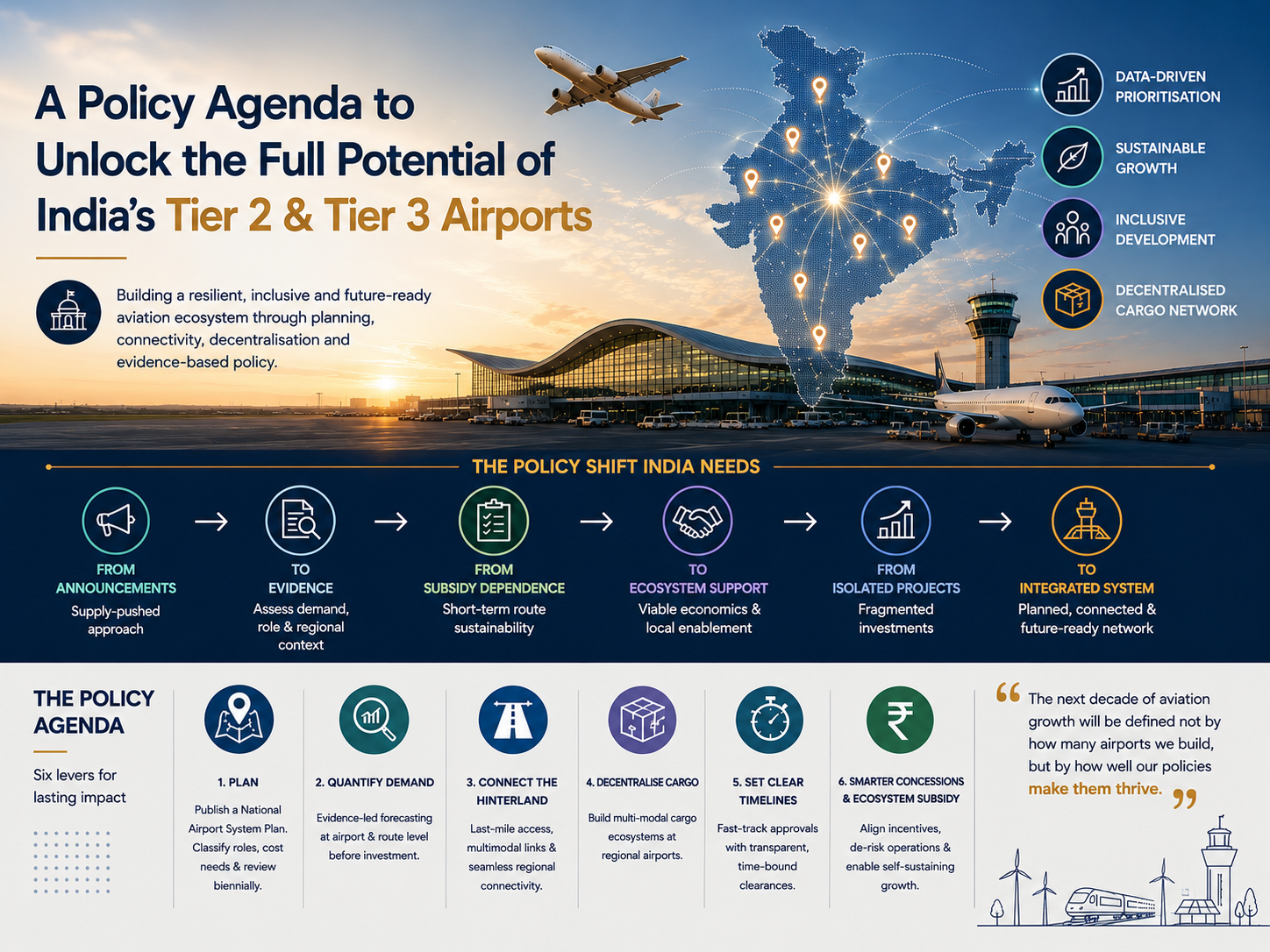
1. Publish a National Airport System Plan
India has an airport pipeline. It does not have a regional or national airport system plan. The distinction matters, and the United States offers the clearest template. Every two years the FAA publishes the National Plan of Integrated Airport Systems (NPIAS) and submits it to Congress. The current edition identifies 3,287 existing public-use airports and estimates USD 67.5 billion of eligible capital development need across roughly 18,100 projects over five years — an 8 percent increase on the prior report. Critically, those estimates are not invented in Washington. They are aggregated upward from each airport sponsor’s own master plan and airport layout plan, then reconciled against state aviation system plans. The document is simultaneously a needs assessment, an eligibility register, and a public audit trail.
The second element India lacks is role classification. NPIAS sorts every facility by the function it performs — primary hubs by enplanement share, and non-primary airports into national, regional, local, basic, and unclassified tiers based on measured activity such as based aircraft, turbine operations, and catchment reach. An airport’s classification determines what it is expected to do and therefore what it is funded to build. A basic airport is not asked to justify a Code 4E runway.
We believe India should publish a National Airport System Plan on a fixed biennial cycle, tabled in Parliament, structured state by state. It should classify all 163 operational airports and the 100 Modified UDAN candidates into functional tiers; cost the five-year capital requirement of each from state and operator master plans; map each airport against its catchment population, GSDP, export clusters, and surface transport alternatives; and report, annually, on delivery against the previous edition. Attaching accountability to the funding allocation matters — this is taxpayers’ money.
2. Quantify the Demand
A system plan sets the hierarchy; project-level assessment decides the sequence. Airport siting in India has too often been supply-pushed — announcements first, traffic studies later. The cost of that inversion is already visible on the ground. Kushinagar opened in 2021 with an international designation and roughly INR 260 crore of public capital behind it; scheduled services ceased in November 2023, and the airport handled 20 passengers across six aircraft movements in FY2026. It is one of fifteen airports the Ministry has confirmed to Parliament as currently non-operational, alongside Pakyong, Shravasti, Aligarh, Kalaburagi, and Ludhiana. None of these failed for want of construction quality. They failed because catchment depth, competing hubs — Gorakhpur airport sits 54 kilometres away and still serves the same catchment, including districts of western Bihar — and post-VGF route economics were never seriously tested before the concrete was poured.
Independent demand modelling for every proposed project before greenfield approval, covering catchment population, GSDP trajectory, surface transport alternatives, export cluster mapping, and multi-scenario 20-year forecasts should be mandated. Modified UDAN’s scheme is well suited to institutionalise this effort: demand evidence should decide which 100 airstrips make the cut. Publishing the assessments would let airlines underwrite Tier-2 opportunities with realistic expectations and would let the public see why a project was rejected. Transparency brings credibility and stakeholder consensus.
3. Ground Access Is Integral to the Success of the Airport
An airport is only as strong as its catchment, and at most Tier-2 facilities the landside story undermines the airside investment. At most metros and Tier-2 cities, passengers spend 60–90 minutes covering 12 kilometres. New airports and major expansions should be required to submit a funded multimodal connectivity plan — committed road delivery timelines, state bus services, or rapid transit — as a condition of Ministry approval, not as a parallel state-government aspiration. State and Centre would need to coordinate since neither is accountable for the door-to-gate journey time that actually determines catchment.
4. Decentralise Air Cargo Deliberately
More than 90 percent of India’s air cargo still moves through six gateways — Delhi, Mumbai, Bengaluru, Chennai, Hyderabad, and Kolkata — with the top four alone accounting for roughly three-quarters of volume. Gujarat’s Ahmedabad–Surat–Rajkot belt exported US$2.4 billion of gems and jewellery in FY2026, close to 9 percent of India’s sector total, and until last year the state had no notified hand-carriage point of origin at all. High-value consignments moved through Delhi, because Delhi was the only airport in the country where they legally could. Mumbai was added in May 2025; Ahmedabad only in December 2025, after sustained representation by the GJEPC.
A dedicated Tier-2 Cargo Development Scheme, held separate from UDAN’s passenger-route logic, should combine export cluster mapping around every Tier-2 airport, capital grants for cold chain and pharma-grade handling, and VGF-type support for dedicated freighter services linked to volume commitments rather than seat-kilometres. With global air cargo rates up 17 percent year-on-year in H1 2026 on constrained supply, the commercial window for a second tier of Indian gateways is open now.
5. Collapse the Clearance Maze
A greenfield airport in India takes 8 to 12 years from announcement to operation (some take longer, such as Navi Mumbai, due to a multitude of reasons). In a market growing as fast as this one, that lag means airports open into demand that may already be lost. No single-window mechanism exists for airports today: the Steering Committee on Greenfield Airports under the 2008 policy only recommends site clearance and in-principle approval, while environmental, defence, and land clearances run on separate tracks, and the National Single Window System digitises applications without statutory power over decision timelines.
Three changes are proposed: a statutory Single-Window Airport Clearance Authority, chaired at Cabinet Secretary level and mandated to resolve all clearances within 18 months for greenfield projects; fast-tracked environmental assessment with deemed-approval provisions for expansions within existing airport boundaries; and a dedicated aviation land acquisition mechanism to support states through the most politically exposed part of the process.
6. Design Financing for Small Markets
Private capital has transformed India’s metro airports but remains wary of Tier-2 and Tier-3 demand risk — largely because the concession structures on offer were built for high-volume assets. Four adjustments deserve serious consideration: a variable concession fee model, with zero revenue share in the early years stepping up against traffic milestones; a sovereign-backed Tier-2 Airport Development Fund providing first-loss equity4 for PPP concessions in secondary cities; the bundling of Tier-3 airports into yield-bearing instruments that unlock institutional capital; and a flexible mechanism, with defined reopener triggers and indexation, so that currency and demand shocks are absorbed contractually rather than through renegotiation.
On the third of these, India is already moving. The third privatisation round proposes to lease 11 AAI airports in five bundles — Amritsar–Kangra, Varanasi–Kushinagar–Gaya, Bhubaneswar–Hubli, Raipur–Aurangabad, and Tiruchi–Tirupati — pairing anchor traffic with small regional facilities so that cross-subsidy operates inside the portfolio. NMP 2.0 contemplates 26 AAI airports for monetisation across FY2026–FY2030, drawn largely from the 0.1–1 million passenger band.
The international precedent is instructive rather than simply encouraging. Brazil moved to block auctions only after three individually awarded concessions came back — São Gonçalo do Amarante, its very first in 2011, followed by Viracopos and Galeão. Research covering all 59 Brazilian concessions is blunt about why: mandated capital expenditure ran ahead of demand, leaving concessionaires servicing debt on cash flows that never arrived, and higher winning bids correlate directly with shorter contract life. Macroeconomic shock, not traffic risk alone, was the dominant driver of renegotiation, and Brazil compounded it in 2017 by making termination cheap enough to become an incentive in its own right. Japan’s bundling of seven Hokkaido airports, awarded in 2019 and phased into operation from June 2020, absorbed a pandemic demand collapse in its first year and remains in force with more than two decades still to run. The lesson for India’s five bundles is that portfolio structure addresses demand concentration and nothing else: capex obligations must track demand, adaptation must be written into the contract, and exiting a concession must stay expensive.
The Path Forward
NCAP 2016 answered the question of whether India should democratise aviation. Modified UDAN, with ten years of committed funding, answers whether the state will stay the course. The open question is execution quality — whether capital flows to demand rather than to announcement, whether airports are connected to the cities they serve, whether cargo warehouses fill, and whether regional routes outlive their subsidies. A published national system plan would not answer those questions by itself, but it would make the answers visible, annually, to Parliament, to states, and to the capital markets that may ultimately fund this. India’s Tier-2 cities are home to the next hundred million fliers and to the export clusters that must compete globally. The infrastructure is being built. The policy architecture that decides where it goes deserves the same level of commitment.
1 ICRA Rating Rationale, 2025.
2 AEL’s Chief Financial Officer, on the FY26 earnings call.
3 Thin route economics refers to the financial and operational dynamics of managing low-density transportation or logistics pathways — such as low-passenger flight routes or secondary freight lanes — where limited demand, high fixed costs, and low volume require specialised pricing or right-sized capacity to avoid persistent losses.
4 Blended-finance structure: the state puts equity into the concession on the explicit condition that its stake is wiped out before the private investor loses anything.