For a generation, airport parking was the closest thing aviation had to passive income. Build a garage near the terminal, price it well above downtown rates, and watch it throw off cash that cross-subsidised everything from terminal operations to debt service. Parking and ground transportation together still account for 20–35 percent of non-aeronautical revenue at the large majority of large-hub US airports. That reliable stream is now under pressure.
Rideshare Bent the Curve
The first shock was transportation network companies. By 2019, Uber and Lyft had overtaken taxis at large-hub US airports, with TNC shares of ground-transport trips ranging from roughly 25 percent at many large hubs to around 35 percent at San Francisco. Research across the three major New York airports found a statistically significant reduction in cars parked following the arrival of ride-hailing. The economics are intuitive: for a traveller weighing a multi-day parking charge against a single drop-off fare, rideshare frequently wins, and every such decision is a parking transaction that never happens.
Airports adapted with a clever piece of financial engineering — charging TNCs a per-trip fee for access to pickup and drop-off zones, converting a competitor into a revenue line. Those fees have become material and are climbing. At Los Angeles, the per-trip TNC fee stood at $4 for pickups and drop-offs into early 2026, and the Board of Airport Commissioners moved to raise it toward $6 per vehicle. The curb, in other words, became the new garage: if travellers would not pay to park a car, they would pay — via the fare — to use the kerb. For now, that substitution has partly offset parking erosion. Autonomy threatens to break the substitution itself.
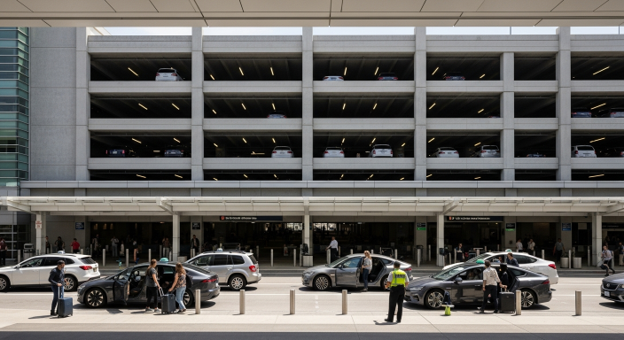
The offset has limits, however. Per-trip fees capture a fraction of what a multi-day parking transaction once yielded, and they invite political and consumer resistance as they climb — airports raising kerb fees face pushback from carriers, TNCs, and passenger advocates alike. Fee escalation also does nothing to solve the physical problem that ride-hailing created: it moved the transaction from the garage to the terminal frontage, concentrating vehicle movements at the single most constrained piece of airport real estate. Newark Liberty’s continued operating-limit adjustments through 2026 are a reminder that frontage and roadway capacity, not parking spaces, are increasingly the binding constraint on ground access at the busiest US airports.
Why Autonomy Is a Different Order of Threat
An autonomous vehicle taxi does not park. It drops a passenger at the terminal and drives immediately to its next fare or to a remote depot. Every ride is a curb transaction and zero parking transactions. Where a private car occupies a revenue-generating space for the duration of a trip, and even a rideshare vehicle is typically a privately owned asset making occasional airport runs, an autonomous fleet is engineered for continuous utilisation — the opposite of parking. Scale that model and the most profitable square footage at many airports, the close-in garage, faces decline in demand.
This is no longer speculative. Waymo is already running on the order of 400,000 paid rides per week across six US cities and expects to exceed one million by the end of 2026. Phoenix Sky Harbor became the first airport in the world to offer rider-only autonomous service, with Waymo pickups and drop-offs handled under the same permitting regime as rideshare and a flat curb fee in the range of $5 per trip; San Antonio International added Waymo service in early 2026, and San Francisco and San Jose have followed.
The Revenue Cliff — and the Congestion Bill
Two dynamics compound. First, direct parking revenue softens as autonomous and rideshare trips displace self-park journeys. Second, curbside congestion intensifies: every drop-off and pickup loads the terminal frontage rather than the garage, and zero-occupancy repositioning — empty vehicles circulating or deadheading between fares — adds trips that generate roadway load without a parked car at the end of them. Airports risk the worst of both worlds: falling parking income and rising ground-access congestion that demands capital to manage.
The financial exposure is significant precisely because parking has been so profitable. Non-aeronautical revenue underwrites credit ratings and capital programmes; a structural decline in its largest single component is a balance-sheet issue, not merely an operational one. The airports most exposed are those with large, recently financed close-in garages and limited flexibility to repurpose them.
There is a second-order effect airports underestimate: the loss of the captive-customer premium. Close-in parking commanded premium pricing precisely because the traveller who chose to drive was a captive customer at the point of return. Autonomy dissolves that captivity — the returning passenger simply summons a vehicle — which removes the pricing power that made parking so profitable in the first place. The revenue question is therefore not only about volume but about yield: even the parking that remains will be harder to price at historic premiums as friction-free alternatives proliferate at the kerb.
Business-Model Responses That Actually Work
The first move is to price the curb as the scarce asset it has become. Dynamic, demand-based pricing of pickup and drop-off zones — higher fees at peak, differentiated by dwell and by vehicle type — converts congestion into revenue and shapes behaviour. Per-trip access fees for TNCs and autonomous fleets should be structured to capture the value of terminal frontage and, critically, to price the externality of zero-occupancy repositioning rather than only completed passenger trips.
The second move is to design for adaptive reuse. New parking structures should be built with flat floors, higher clear heights, and external ramping so they can be converted to other uses — logistics, offices, even terminal functions — as parking demand falls. The third move is to consolidate and monetise the ground-transport ecosystem holistically — cell-phone lots, staging areas, charging infrastructure, and dedicated autonomous pickup zones — treating the entire kerb-to-fleet chain as one commercial system rather than a set of legacy silos.
Underpinning all three is technology and data. Airports need curb-management systems that meter, price, and enforce access dynamically; geofenced pickup zones that keep autonomous fleets out of congested frontage; and the passenger-data relationships that let them capture value from the journey even when they no longer own the parking transaction. There is also a land-use dividend: as parking demand softens, close-in acreage currently locked up in surface lots and garages becomes available for higher-value airport-city development — hotels, offices, logistics, and commercial real estate that can generate non-aeronautical revenue far more durable than a parking space. The airports thinking two moves ahead are already reserving that optionality in their master plans.
Avinia’s View
Airport finance teams should be modelling the parking-revenue cliff now, with explicit scenarios for autonomous penetration, and stress-testing capital plans that assume parking income holds flat. The strategic posture is to shift from monetising storage to monetising access: reprice the curb dynamically, structure fees to capture repositioning trips, and stop building single-use garages. The airports that treat autonomy as a forcing function to modernise ground-transport economics — rather than a threat to be resisted — will convert a revenue risk into a pricing opportunity.