A Structural Outlier in a Privatised World
Public-private partnerships have reshaped airport infrastructure globally over the past three decades. London Heathrow, Paris Charles de Gaulle, Singapore Changi, and Sydney Airport all operate under privatised or corporatised models that have driven sustained capital investment, service quality improvement, and commercial performance. In Latin America, long-term concession agreements at airports including Santiago’s Arturo Merino Benítez International and across Mexico’s Grupo Aeroportuario networks have mobilised billions in private capital while demonstrating measurable improvements in efficiency and passenger experience. The global track record for airport P3s, structured carefully, is broadly positive.
The United States stands apart. Despite operating the world’s largest aviation market by passengers and revenue, and despite significant and growing infrastructure investment requirements, the US has seen minimal adoption of full-scale airport P3s. The most prominent example remains Luis Muñoz Marín International Airport in San Juan, Puerto Rico, leased to a private operator in 2013 and the only major US airport to have undergone a full long-term concession to date. The exception proves the rule. Structural, regulatory, and political barriers have kept the US airport sector firmly in the public domain.
Why the US Has Stayed Public
The barriers to P3 adoption in US airports are multi-layered and mutually reinforcing. Understanding them clearly is a prerequisite for designing reforms that actually work.
Financial structure is the foundational issue. Publicly owned airports benefit from tax-exempt municipal bond financing that private investors cannot access. This creates a structural cost-of-capital advantage for public operators that makes P3 arrangements less competitive from the outset. Private partners must generate returns that more than offset this financing differential — a challenge that has made the economics of full airport privatisation difficult to close in the US market.
Regulatory constraints compound the disadvantage. Airports receiving federal funding must comply with strict FAA rules on pricing, revenue use, and operational standards. These rules curtail the commercial flexibility that private operators depend on to generate acceptable returns. Airlines add another layer of friction. Embedded in long-term use-and-lease agreements, carriers hold significant influence over airport governance and have historically resisted privatisation over concerns about higher fees and reduced operational control. Under current FAA rules, airport privatisation under the AIPP requires the consent of 65 percent of the air carriers serving the airport — a threshold that effectively gives a small number of legacy carriers veto power over any privatisation proposal.2
Political and community resistance reinforces the status quo. Airports are high-profile public assets, and privatisation proposals consistently attract pushback from local governments, labour unions, and residents concerned about job security and service quality. Paradoxically, the financial health of the sector also reduces urgency: many US airports are operationally stable under public management, leaving little crisis-driven pressure to restructure ownership or governance.
What Terminal-Level P3s Have Demonstrated
The development in recent years has not been at the whole-airport level, but at the terminal. The $4 billion1 redevelopment of LaGuardia Airport’s Terminal B, structured as a Design-Build-Finance-Operate-Maintain (DBFOM) contract and delivered by LaGuardia Gateway Partners, is the most cited proof point — and justifiably so. It demonstrated that complex, large-scale airport infrastructure can be delivered with private capital and private management capability within the constraints of the US regulatory environment. Similar DBFOM arrangements are underway at JFK, where terminal redevelopment programmes are drawing significant private investment under long-term concession structures.
Terminal-level P3s work in the US context for a specific reason: they are compatible with the existing ownership and governance framework. The airport authority retains ownership of the land and airfield. Airlines can be engaged on the specific terminal arrangement rather than a whole-airport governance restructure. Federal grant conditions can be managed at the project level. The political surface area of a terminal P3 is substantially smaller than a full airport privatisation. This is the model the US can build from.
LaGuardia Terminal B: What the Completed Terminal Delivered
For most of its modern history, LaGuardia Airport was the most visible argument against American exceptionalism in infrastructure. Terminal B, built in 1964 and nominally renovated several times since, processed roughly 15 million passengers annually through a facility that was structurally inadequate, operationally inefficient, and commercially unviable. A 2014 remark by then-Vice President Biden that arriving at LGA felt like landing in a third-world country circulated widely because it was accurate.
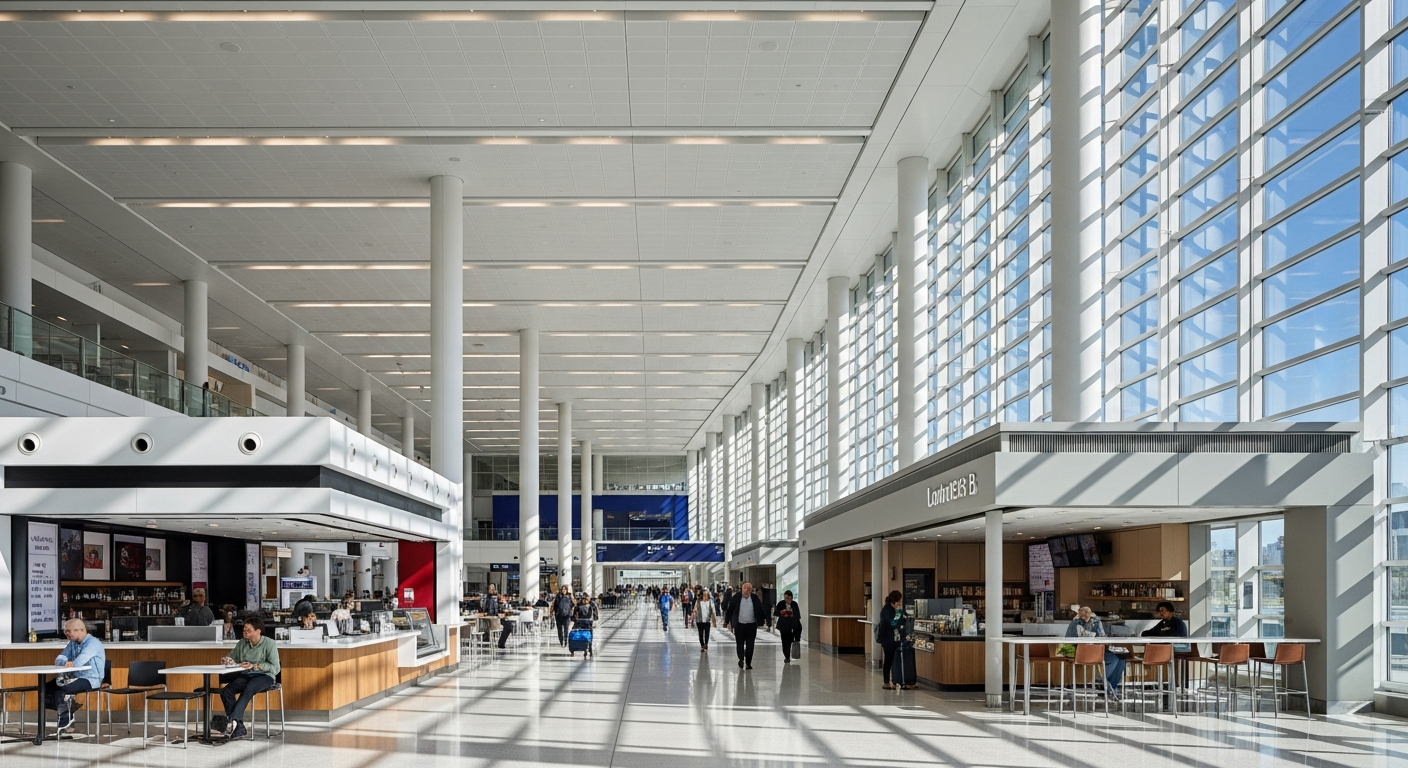
The new Terminal B central hall — a 110,000 square-foot column-free space with 52-foot ceilings and extensive natural light — replaced a facility that had been cited by the FAA for structural deficiencies. Retail and food-and-beverage space increased relative to the previous terminal, with concession revenue per enplaned passenger materially above the pre-redevelopment baseline. Security checkpoint throughput improved through a redesigned layout and expanded lane count. Aerobridges replaced a previous mix of jetways and stair-trucks. By 2024, Terminal B was regularly cited alongside new international terminals as a benchmark for US airport commercial quality — a reversal that would have seemed implausible a decade earlier.
From a financial perspective, the consortium delivered the $4 billion programme within its fixed-price envelope despite a complex phased construction schedule in one of the most expensive construction labour markets in the country. The Port Authority achieved its primary objective: a $4 billion asset delivered without a commensurate increase in its own debt. This off-balance-sheet outcome is the core financial value proposition of the P3 model for public sponsors.
Reform Agenda
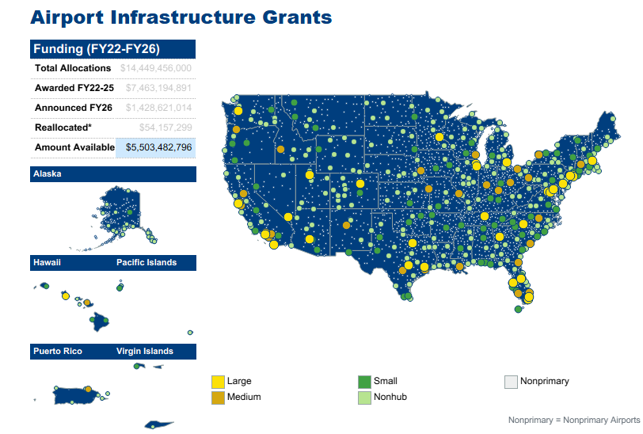
The Airport Infrastructure Grant (AIG) programme will end in 2026. Airports that have relied on IIJA capital to fund infrastructure investment will face a material funding shortfall from 2027 onwards — creating the most compelling argument for P3 adoption the US market has seen in a generation. The map below shows each airport with funding allocations and the projects underway.
Source: FAA
The path to unlocking broader private capital participation in US airport infrastructure runs through five targeted areas of reform. None requires full privatisation.
Reform the AIPP. The Airport Investment Partnership Program is the legal gateway for airport privatisation, but it is functionally underused. Streamlining the approval process, relaxing the 65 percent air carrier consent requirement — or replacing it with a framework where consent is presumed unless a carrier can demonstrate material harm — and clarifying rules around revenue use would make the programme significantly more viable. It is important to note that the consent requirement applies to full airport privatisation under AIPP, not terminal P3s. Terminal-level DBFOM arrangements like Terminal B operate outside the AIPP framework entirely, which is partly why they have proliferated while full airport privatisation has stalled.
Scale the terminal-level P3 model. Since full airport privatisation faces resistance, the pragmatic near-term path is expanding what already works. Developing a standardised federal template for DBFOM terminal contracts — with model contract structures, risk allocation frameworks, procurement guidelines, and performance benchmarks drawn from LGA and JFK — would lower transaction costs substantially and enable mid-size airports to pursue similar arrangements without reinventing complex deal structures from scratch each time.
Align P3s with federal infrastructure funding. The FAA has released the fifth and final instalment of $2.89 billion in funding for US airports. The AIP will continue to fund beyond 2026 with an appropriation of approximately $4 billion per year, distributed by formula across 3,300+ eligible airports. Federal grants and private capital do not combine easily. Grant conditions can restrict the operational flexibility that private partners require to generate adequate returns. A targeted policy clarification allowing airports to layer IIJA grants with private financing for discrete project components — terminals, ground transportation links, cargo facilities — would unlock hybrid funding structures that capture the benefits of private capital without requiring full privatisation.
Address airline consent and revenue constraints. Airlines’ embedded influence over airport governance is one of the most consequential but least-discussed factors in P3 adoption. Updating FAA revenue diversion rules to give airports more flexibility in how P3 proceeds are reinvested, and encouraging airports to renegotiate use-and-lease agreements with shorter terms, would meaningfully shift the dynamic.
Political and community resistance to P3s is often rooted in unfamiliarity rather than firm opposition. Airport authorities, in partnership with federal agencies, can counter this by proactively communicating the benefits of private participation and using completed projects as tangible proof points. A knowledge-sharing platform where airports can access case studies, legal templates, and lessons from completed P3s globally would help bring transparency and build trust in the process for smaller and mid-tier airports that lack in-house transaction expertise. Equally important is pursuing lower-controversy projects first — ancillary facilities, cargo infrastructure, ground transportation links — to build public trust and institutional capability before tackling more politically complex arrangements.
Avinia’s View
The United States does not need to privatise its airports wholesale to benefit from private-sector participation. What it needs is a regulatory and financial environment where P3s are a genuine option rather than an exceptional one. The barriers are real, but they are policy choices.
The IIJA has made federal capital more accessible for airport development. That is good for the sector in the short term. But with the US total gross national debt $2.70 trillion higher than one year ago, federal grants are not a substitute for the commercial discipline, innovation capacity, and long-term capital commitment that private-sector participation can bring. The infrastructure development could be led by ways that combine public oversight with private capital.
1 The $4 billion figure represents the Terminal B P3 contract value; the broader LaGuardia Airport redevelopment programme, including Terminal C and associated infrastructure, totalled approximately $8 billion.
2 Consent is required from 65% of air carriers by number of carriers and 65% by total landed weight — both thresholds must be met. The landed weight threshold is the more consequential one in practice, because at most large-hub airports one or two hub carriers control more than 65% of landed weight, giving a single dominant carrier an effective veto regardless of how many other airlines agree.