The Airport’s Unsolved Problem
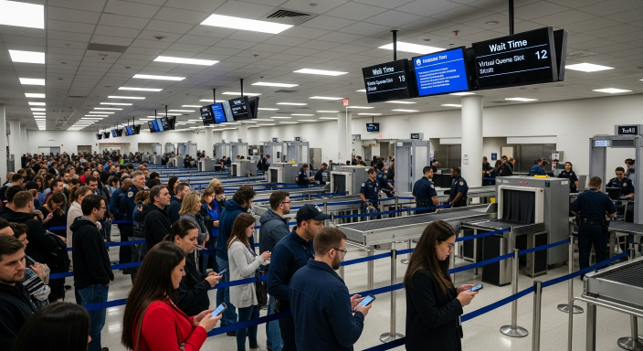
Though the aviation industry solved many friction points at the passenger terminal, one part of the journey remains stubbornly unreformed. The security checkpoint continues to be one of the most frustrating touchpoints in the airport journey for a significant share of travellers. The Aviation Cooperative Research Program (ACRP) has commissioned a study to develop a primer, guide, and tools — including a decision tree, flow chart, and scorecard — to help airport practitioners evaluate and implement, if appropriate, virtual queuing solutions for managing demand at the security screening checkpoint. The outcome of the study is not yet publicly released, though the industry eagerly awaits the guide.
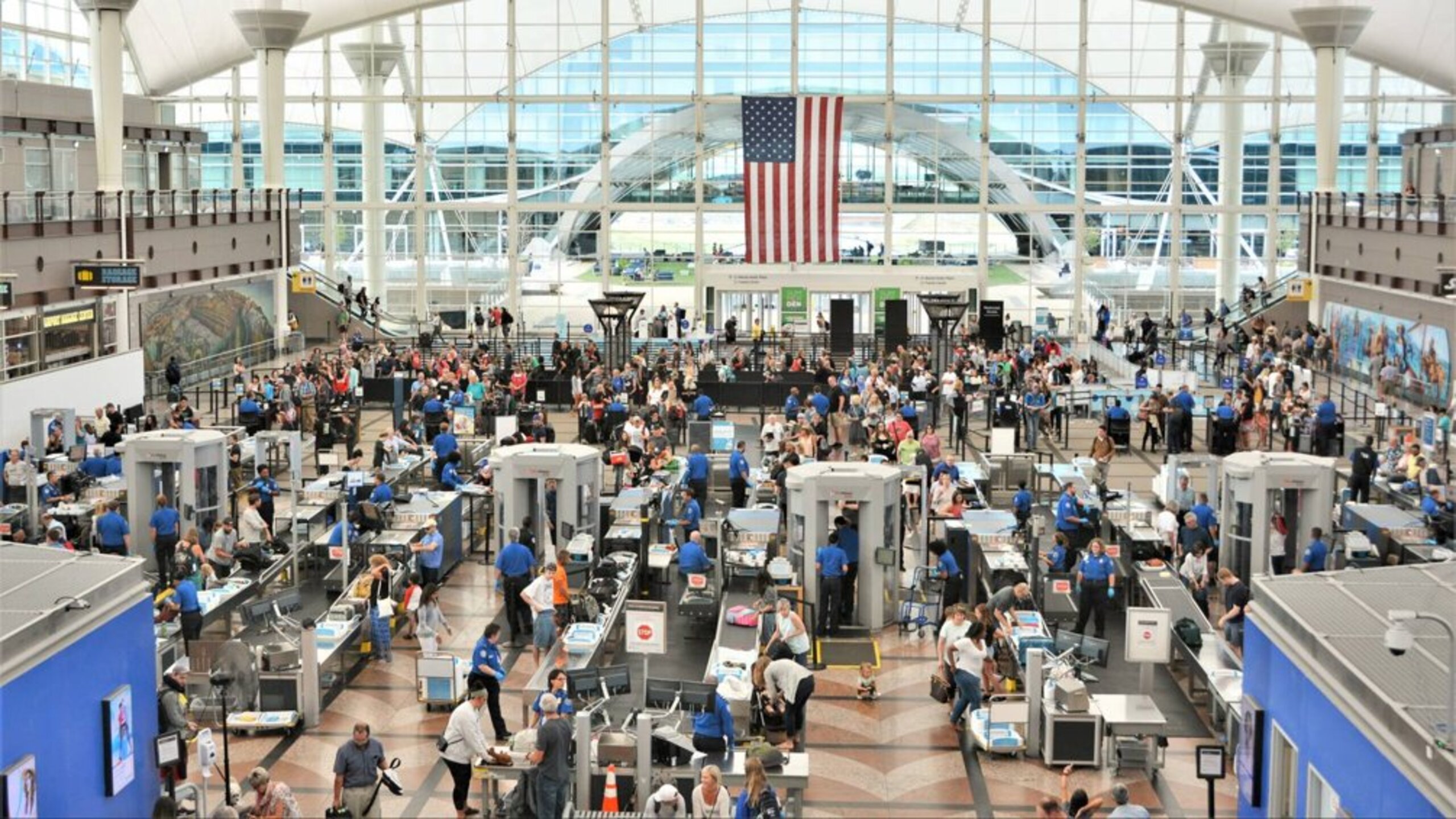
The economics of this frustration are real. Passengers stuck in long security queues arrive at the gate with less discretionary time and less money spent on retail, food and beverage (F&B). Airport concession revenues are directly correlated with passenger dwell time in the secure zone; research consistently indicates that every additional minute of secure dwell time generates meaningful incremental spend per passenger.
Virtual queuing offers a credible path to disrupting this dynamic. The concept is straightforward: rather than requiring physical presence in a line, passengers are assigned a time window for checkpoint processing. The queue still exists, but it is virtual, and not concentrated at a single pinch point.
Learning From Adjacent Sectors
Virtual queuing is not a new idea. Disney introduced FastPass in 1999, a system that has since evolved into a fully dynamic demand management platform. Healthcare systems use appointment scheduling — a form of virtual queuing — to manage patient flow. Retailers from Apple to IKEA have deployed queue management systems that replace physical waiting with mobile notifications. The concept has proven itself across industries where demand is concentrated, capacity is constrained, and the customer experience consequence of waiting is high. Airports meet all three conditions.
The more instructive examples are from inside the airport perimeter itself. Concessionaires and service providers at major airports have begun deploying virtual queuing for lounge access, premium services, and customer support. Several international airports — particularly in the Middle East and Europe — have piloted appointment-based security systems for priority lanes. The Automated Passport Control and CBP Mobile Passport systems at US ports of entry represent early steps toward demand-managed processing at border checkpoints. The infrastructure and behavioural models are converging.
Designing for the Checkpoint Environment
Translating virtual queuing from adjacent sectors to the security checkpoint requires navigating a set of constraints that have no direct equivalent in retail or theme parks.
The physical geometry of security checkpoints is non-trivial. Pre-screening and screening areas at most US airports were designed for throughput optimisation under a first-come, first-served model, not demand-managed flow. A virtual queuing system must be designed around the specific layout of each airport terminal — the available holding space, the number of lanes, the position of Walk-Through Metal Detector (WTMD) and CT scanner banks, and the physical flow from check-in through to the secure zone. Airport terminals with centralised security zones face different design challenges than those with distributed checkpoint clusters across multiple concourses.
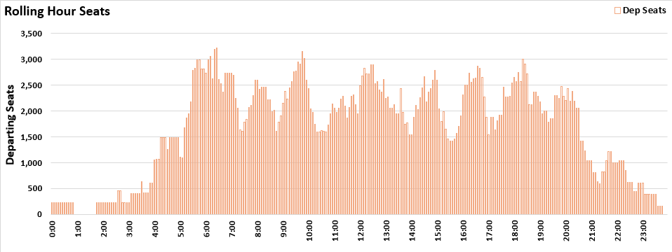
Sample departing seats rolling hour
Demand profiles matter enormously. A virtual queuing system that works well during predictable peak periods — Monday morning business travel at a hub airport — will face harder conditions during irregular operations, weather events, or special events that compress demand into unexpected patterns. The system design must account simultaneously for diurnal patterns and passenger profile: the frequent flyer who manages her slot to the minute, and the infrequent traveller who arrives at the wrong time regardless of what the app instructs.
An example of a demand rolling hour is shown above for a predominantly Origin-Destination (O-D) airport in India. The rate of change matters as much as the peak itself: the system goes from near dormancy to maximum load in under two hours early in the morning — a demand profile typical of many business-travel-dominated airports globally. A virtual queuing algorithm that sets slot intervals based on yesterday’s throughput rates could cause a mismatch between predicted and actual arrival rates at the security checkpoint, and the consequences — a queue forming faster than the system can adapt to — compound quickly.
The opportunity is that the inter-bank troughs are the natural slot for absorbing early arrivals and clearing any backlog from the preceding bank. The trap is that passengers do not observe bank boundaries; a passenger holding a slot for a bank-three departure who arrives early will join the bank-two queue and inflate apparent demand precisely when the system is expecting it to ease.
The downstream and upstream interplay is also critical. The security checkpoint does not sit in isolation. Its throughput is constrained by arrivals from check-in and the upstream flow from ground transportation, and it drives what arrives at gates and in concession areas. A virtual queuing system that smooths checkpoint demand without coordinating with upstream passenger arrival patterns — driven by check-in systems, ground transportation schedules, and airline departure profiles — will create new bottlenecks rather than eliminate existing ones. The most effective implementations will be designed as components of a broader demand management architecture, not standalone point solutions.
The passenger-facing interface is the most visible component, but it sits above a more complex infrastructure layer. An effective virtual queuing system for security checkpoints requires real-time processing rate data to assign realistic time slots, dynamic adjustment capability as conditions change, integration with airline departure data to prevent slot assignments that conflict with boarding close-out times, and a passenger notification system capable of reaching travellers across a range of devices and engagement behaviours.
The Adoption Hurdle
The adoption problem is arguably harder than the algorithm problem. A virtual queuing system that 60 percent of departing passengers ignore does not manage demand — it creates a two-tier queue where the compliant minority holds slots while the non-compliant majority walks up and forms a conventional line anyway, destroying the throughput model the system was designed around.
The single most important design decision is where in the journey enrolment is solicited. Most pilot deployments have placed the sign-up moment at the airport — a QR code at the terminal entrance, a kiosk near the checkpoint, a push notification triggered by geofence. By the time a passenger is at the terminal, their luggage is in their hand and cognitive bandwidth is at its lowest. Enrolment rates at terminal touchpoints consistently underperform pre-journey channels by a large margin.
The correct enrolment window is the 24-to-48 hour pre-departure period, embedded inside processes the passenger is already completing. The check-in confirmation screen — the moment the passenger receives their boarding pass — carries high attention. A single-screen slot selection prompt inserted here, requiring one tap to accept a suggested window or two taps to choose an alternative, captures the passenger at peak engagement. Airlines control this touchpoint entirely; the airport’s integration requirement is an API that accepts a PNR and returns an available slot window.
Airport app as an enrolment channel has a structural limitation. The core issue is penetration. Current install rates for standalone airport apps are low relative to airline app penetration, concentrated among frequent business travellers, and drop sharply for passengers originating from outside the primary catchment.
The airport app’s structural advantage is that it is not airline-specific. A passenger with a connecting itinerary involving two airlines, or a family group with split bookings, can consolidate their virtual queue management on a single interface that the airline app cannot provide.
The cleanest airport app enrolment mechanism mirrors what the check-in flow does in the airline app: it fires the slot assignment process the moment a boarding pass is detected. If the passenger adds their boarding pass to the airport app’s wallet — either by scanning the barcode or through an airline API integration — the app should immediately request a slot, display the recommended window with a one-tap confirm, and store the confirmation locally and in the backend against the PNR. No separate sign-up screen, no queue management menu to navigate to. The enrolment happens as a side effect of a task the passenger was already completing.
Freemium, or Priced?
The case for a free offering is strong on passenger experience logic: if virtual queuing meaningfully reduces checkpoint friction, the benefit should flow to the broadest possible base. Congestion pricing — charging more to access a constrained resource during peak demand, to shift discretionary demand to off-peak periods and fund capacity investment from the revenue generated — is a win for the airport.
A hybrid model is possible: a free virtual queuing tier with optional premium windows for passengers willing to pay for greater certainty — specifically, slot timing preference and the ability to choose a specific window rather than accepting the algorithmically assigned one. The baseline virtual queue system assigns a slot; the paid upgrade lets the passenger select any available window that suits their schedule. This will require sophisticated algorithms and real-time data.
Avinia’s View
The busiest airports could gain a durable advantage both in passenger experience performance and in the commercial metrics that drive long-term revenue. The key is not to overcomplicate the technology or the pricing model. The pricing architecture must be designed to serve the system’s primary purpose — demand smoothing — not to maximise revenue at the expense of the experience it is meant to improve. Start with a free, universally accessible offering at a single terminal or checkpoint zone. Measure throughput, dwell time, and satisfaction rigorously. Build the relationship before the technology, not after. Use the data to make the case for broader rollout. The ACRP guidebook (work in progress) could be a useful implementation guide for the pilot rollout. The moment to run that pilot is now.