The Problem With Today’s Control Room
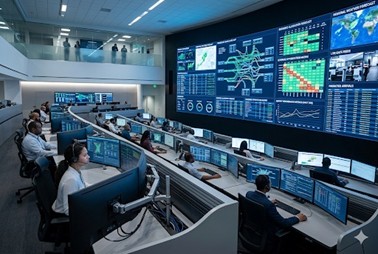
Walk into the Airport Operations Control Centre (AOCC) at any large airport today, and you will find a room designed around coordination. Airline duty managers, ramp tower controllers, ground handler dispatchers, ATC liaisons, CISF and immigration representatives, and airport operations staff sit shoulder to shoulder, sharing screens and radios to manage the day as it evolves. The architecture of that room — physical and procedural — is built on a single assumption: that disruption is unpredictable, and that the best the operator can do is coordinate quickly once it occurs. Though that assumption still largely holds true, it is no longer adequate. It was reasonable in an era of lower traffic volumes and less integrated supply chains.
DGCA on-time performance data for 2025 shows that on-time performance at India’s six metro airports ranged from the mid-70s to high-80s across metros through 2025, with IndiGo averaging 87–90% and the system trailing in fog-affected months. By IATA’s global rule of thumb of roughly USD 75 per delayed minute, the system-wide annual cost of delay at India’s six metros runs to several hundred million USD.
A meaningful proportion of those delays does not originate in the air or with the carrier — it originates on the ground, in the airport-controlled environment that the AOCC is supposed to govern: stand availability, ground handling resource allocation, ramp congestion, baggage system throughput, and the dozens of small dependencies between an aircraft’s on-block time and its next departure slot.
What AI Changes — and How
Traditional AOCC tools — A-CDM dashboards, AODB feeds, gate management systems — describe what is happening now. A traditional form of representing gate utilisation has historically been the Gantt chart: a static, deterministic gate plan with visible utilisation variance, long buffers on some gates and tightly stacked turns on others. The chart was built iteratively and was very manual and time-consuming to produce. It captured the schedule. It did not anticipate it.
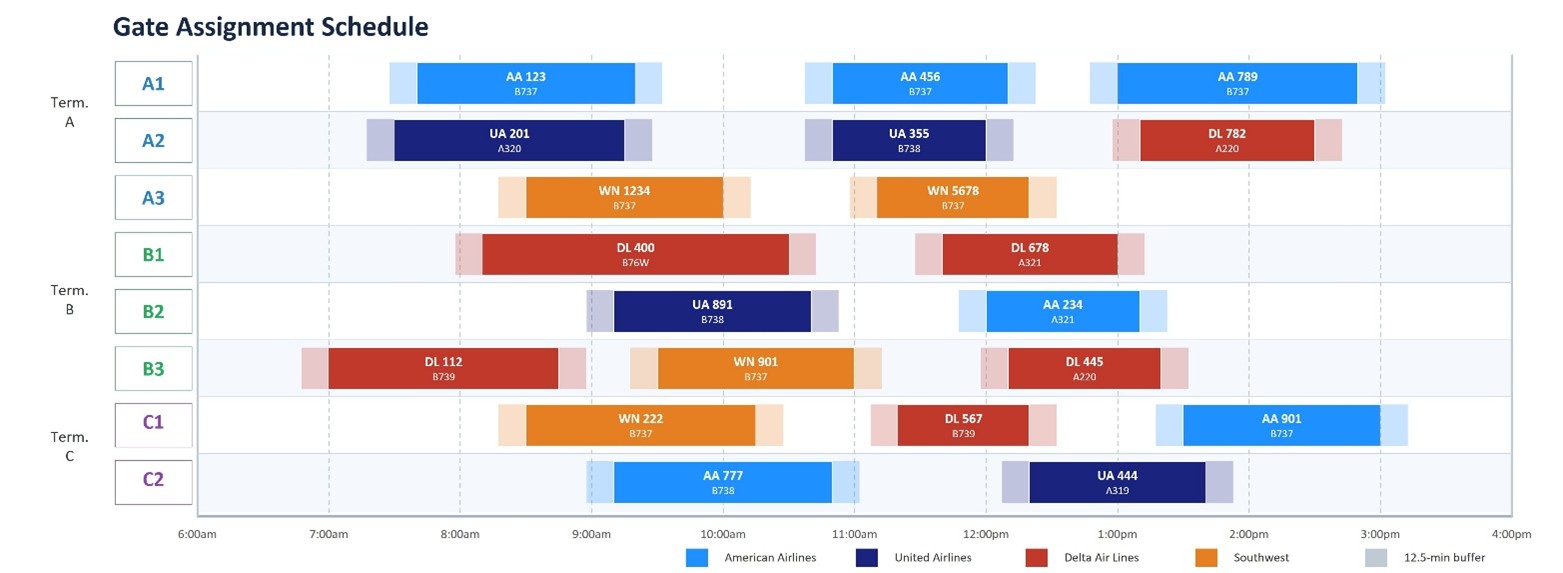
Representative Gantt Chart
With Machine Learning and AI, tools are now being adopted that bring a host of additional layers for the airport operational manager to make decisions in a live environment.
Real-time predictive re-allocation. Combining live chocks-on/off-block data with predictive turnaround completion models lets the system reassign downstream gates 60–120 minutes ahead of conflict, before the duty manager has to scramble. ML models trained on historical actual-versus-scheduled distributions assign gates based on probability-weighted on/off-block windows, not single-point estimates.
Buffer compression. Visible white space between aircraft turns is insurance against uncertainty. ML can shrink buffers where the data supports it — and unlock 5 to 10 percent additional stand capacity at the peaks. At a capacity-constrained airport like Mumbai (CSMIA), where stand availability frequently becomes the binding constraint, that 5 to 10 percent is the difference between accepting and refusing summer slot requests.
Resource optimisation. At Indian airports the real bottleneck is not always the gate availability — it is GSE, pushback tugs, or ground handler staff. Co-optimising gate, equipment, and crew allocation as an overall KPI reduces equipment idle time without compromising service levels.
Predictive AI systems, trained on historical flight performance, real-time weather feeds, passenger flow models, ground service event logs, and stand allocation histories, can model the state of an airport’s operations not just now, but two, four, or six hours from now — to drive pre-emptive decision-making rather than reactive coordination.
Measurable Value — Global and Indian
Deployments now in the field — Heathrow, Schiphol, Changi, Frankfurt — are generating consistent operational improvements across several categories. The international hubs are one step ahead at the AOCC backbone layer. Indian deployments are catching up quickly, with several at the apron and turnaround layer and one — Hyderabad — fully integrated.
| Airport | Platform / Vendor | Scope & Capability Layer | Status | Documented Outcomes | Source Type |
|---|---|---|---|---|---|
| Seattle-Tacoma (SEA) | Assaia ApronAI / TurnaroundControl (computer vision over Safedock A-VDGS cameras) | Apron turnaround tracking; Predicted Off-Block Time (POBT); real-time chocks/people/equipment compliance | Production. Passed Assaia’s millionth-turn milestone with Alaska Airlines | 9-min reduction in average gate-hold time; ~$5M annual savings; ~1 min taxi-in time saving per flight; 3.9 min reduction in gate departure delays for delayed flights | Vendor case study (Assaia) |
| JFK Terminal 4 / New Terminal One | T4: Assaia ApronAI. NTO: Searidge Virtual Ramp Control + Smart Stand, integrated with ADB SAFEGATE OneControl / Intelligent AiPRON | T4: apron turnaround optimisation, POBT. NTO: full virtual ramp control — comprehensive visual coverage, ground surveillance fusion, AI-driven stand management | T4: scaled from 10-gate pilot to additional 47 gates from July 2025. NTO: targeted full implementation Fall 2025 | T4: up to 5 min less ground delay per flight. Cross-portfolio Assaia data: ~6% ground delay reduction, ~4% turnaround time improvement, up to 25% more turns per gate. | Vendor / press release |
| Dallas/Fort Worth (DFW) | Jacobs + PA Consulting (AI/ML strategic transformation programme). Willow Copilot (digital twin / AI assistant for built environment) | Enterprise: digital twin of utilities and assets; predictive maintenance; AI Copilot for facilities workforce; AI/ML across operations, sustainability, passenger flow, cargo | Programme launched October 2025 with Jacobs/PA Consulting. Willow Copilot live in DFW environment. Terminal F development integrating sensor architecture | DFW leadership has publicly cited an estimated $8–16M annually in projected added value from AI-enabled improvements from disruption reduction and concession uplift (DFW-stated). Specific OTP, turnaround, or stand-utilisation figures not yet disclosed. | Programme announcement / operator-stated |
| Singapore Changi | Aircraft 360 (CAG-led) on a computer vision + AI stack; A-CDM ecosystem with airlines, GHAs, ATC. ADB SAFEGATE Intelligent AiPRON in the broader stack | Apron turnaround decomposition into ~70+ component events; early delay flagging; gate planning integration; resource allocation across airline-GHA-ATC seam | 2024 trial across 5 stands. Rolling out to Terminals 2 and 3. Embedded in Changi’s Smart Airport / Terminal 5 strategy | Departure OTP improvements reported (magnitude not publicly disclosed). Capacity uplift modelled at +12 flights/day at full scale. Used by gate planners, GHAs, ATC, and airlines as A-CDM input | Operator publication (Changi) |
| Heathrow (LHR) | AIRHART by Smarter Airports (JV of Copenhagen Airports and Netcompany) | Full AOCC digital backbone — AODB replacement, A-CDM modernisation, AOP (Airport Operations Plan) with predictive, continuously-optimised operating plan; AI-driven situational awareness across the airport ecosystem | Selected March 2026. Multi-year phased rollout under way | Not yet published — deployment is in early phase. | Operator + vendor announcement |
| Amsterdam Schiphol | Deep Turnaround (Schiphol-developed, deep-learning over apron camera feeds); machine-learning-driven gate stand planning | Apron turnaround event detection (70+ unique events tracked across 30 turnaround processes); predicted off-block time; gate planning integration; buffer-time optimisation | Operational on 52 stands. Expanding to all ~100 stands. Used by gate planners, ground handlers, ATC, and participating airlines | 25% reduction in last-minute gate changes; up to 1 percentage point OTP improvement at the system level; delays detected up to 40 minutes before targeted off-block time; reduction of inter-flight buffer time enabling capacity uplift | Operator publication (Schiphol) |
| Hyderabad Airport (HYD) | GMR Airports NextGen APOC (AI-powered digital twin); built on WAISL Limited’s technology stack (WAISL is GMR’s airport-IT JV with SITA) | End-to-end integrated digital-twin AOCC covering terminal, airside, and landside in a single platform. Integrates 40+ operational modules and tracks 100+ KPIs. Multi-stakeholder collaborative decision-making layer linking airlines, ground handlers, and ATC. Predictive analytics on operational state; proactive disruption response. | Launched December 2024 — India’s first end-to-end fully integrated digital-twin APOC. Designated as the standard operating model for phased rollout across GMR’s airport portfolio: Delhi (DEL), Goa Mopa (GOX), Visakhapatnam, and Bhogapuram. | Architected for 40M+ annual passengers (current capacity envelope). Operator-stated benefits: comprehensive situational awareness, proactive operational response, improved on-time performance and passenger experience. Specific quantified OTP, turnaround, or efficiency uplift figures not yet publicly disclosed. | Operator press release (GMR Airports, 11 Dec 2024); IndiaAI; Passenger Terminal Today |
Hyderabad (HYD). GMR Airports launched India’s first end-to-end fully integrated AI-powered digital-twin Airport Predictive Operation Centre at Rajiv Gandhi International Airport in late 2024. The NextGen APOC covers terminal, airside, and landside operations, integrates with over 40 modules, and tracks more than 100 KPIs. The platform is capable of managing more than 40 million passengers annually. GMR has confirmed that the digital-twin platform will be adopted as the standard operating model across all GMR-operated airports in a phased manner — which includes Delhi, Goa Mopa, Visakhapatnam, and Bhogapuram.
Bengaluru (BLR). BIAL has partnered with KPMG to implement a generative AI platform for airport operations focused on real-time data processing, predictive analytics, and adaptive intelligence. The airport has also deployed an AI-powered airside safety system designed to prevent runway incursions and ramp incidents — applications adjacent to the AOCC stack and increasingly integrated with it.
Delhi (DEL). Indira Gandhi International Airport has implemented an AI-powered Unified Total Airside Management (UTAM) system to streamline airside operations. Delhi is also the natural next deployment site for GMR’s digital-twin APOC, given the operator’s stated rollout plan.
Heathrow (LHR). AIRHART integrates data across the full airport ecosystem and applies machine learning to generate operational forecasts and decision support in real time. At around 480,000 aircraft movements annually and capacity utilisation exceeding 98 percent, Heathrow is the most demanding test environment in global aviation. The deployment is a useful reference case for Mumbai (CSMIA), which operates above 95 percent slot utilisation in peak season.
The Business Case for Indian Airport Operators
The economics are straightforward at India’s metros. Delhi handles roughly 460,000 commercial aircraft movements annually. At that throughput, a one-percent improvement in operational efficiency translates to an estimated INR 65–85 crore in direct cost and delay-related economic value per year.
Fuel saved at Delhi from a 1% efficiency improvement: ~2,070 tonnes of jet fuel per year (≈ INR 27 crore at May 2026 ATF prices, fuel-only)
All-in economic value: INR 65–85 crore per year (using EUROCONTROL’s 2.5–3x multiplier to capture non-fuel delay costs)
Mumbai’s figure, at slightly lower movement volumes but higher slot-constraint premium, is INR 50–70 crore. Hyderabad, growing past 35 million passengers per year in the near term, and adding a second runway, is now firmly in the band where predictive APOC programmes pay back well within the implementation cycle. Even at smaller hubs — Chennai, Kolkata, Ahmedabad, Goa Mopa — the upside is significant annually, against an implementation programme that is typically a multi-year, eight-figure rupee investment.
Airports that defer this decision will pay for it twice: once in the retrofit, and once in the operational losses of the years in between.
Avinia’s View: This Is an Operational Transformation
Airport operators often approach AI in the AOCC as a technology procurement exercise — identify a vendor, run a proof of concept, buy a platform. The results are consistently disappointing. The platform works; the organisation does not change; the outcomes do not materialise. We have seen this pattern more than once in the last two years.
The harder change is the operating model the technology enables. The shared-data agreements that underpin predictive operations require carriers, ground handlers, AAI ATC, CISF, and airport authorities to commit to a level of operational transparency that most Indian stakeholder relationships are not currently structured for. Data ownership disputes, commercial sensitivity over load factors and turnaround performance, and the absence of a contractual basis for joint performance accountability between airport operator and ground handler all bite hard once the pilot ends and scaling begins.
The airports extracting real value started with the operational use cases — what decisions do we want to improve, by how much, and what would it be worth — and built the data infrastructure, governance frameworks, and change management programmes around those decisions. The AI platform came last, not first. As India’s metro airports run progressively closer to their slot ceilings, this sequencing is no longer optional. It is the difference between a control room that responds to the day and one that has already planned for it.