More Than a Green Wall
Airports are, by design, among the most stressful environments humans regularly move through. They are large, loud, and structurally engineered for throughput rather than comfort. The clock is always running. Which is precisely why biophilic design has found such fertile ground here. Studies across neuroscience and environmental psychology have shown that exposure to natural elements lowers heart rates, reduces blood pressure andimproves cognitive function.
The business case is direct. Calmer passengers dwell longer, spend more at retail and food and beverage, and form more positive associations with the airport brand. There is also a wayfinding dimension. Large terminals are inherently disorienting. Distinctive natural installations can function as memorable landmarks in a way that signage alone cannot. Passengers anchor their spatial memory to the garden, not the gate number.
But it is not without challenges. Terminals are usually deep-plan buildings where natural light does not reach everywhere. They run under continuous mechanical ventilation. Airside zones near boarding gates open repeatedly onto the tarmac, creating thermal stress on living plants.
We spoke to a senior landscape head at one of India’s busiest airports to understand the real deeper problem here. It is about when and how the decision for landscaping in a terminal is made. In most airports, the landscape planning and design enter the conversation very late. The architects develop the envelope and structure, MEP packages get coordinated, the concession layout takes shape, and somewhere in detailed design or even tender stage, the question of internal landscaping arrives. Planted zones get fitted into the residual footprint between circulation routes, retail counters and baggage belts. The visible result may still be impressive. The operational reality, eighteen months later, is a horticulture team running hard to maintain a programme that the building was never designed to host.
The Daylight Decision
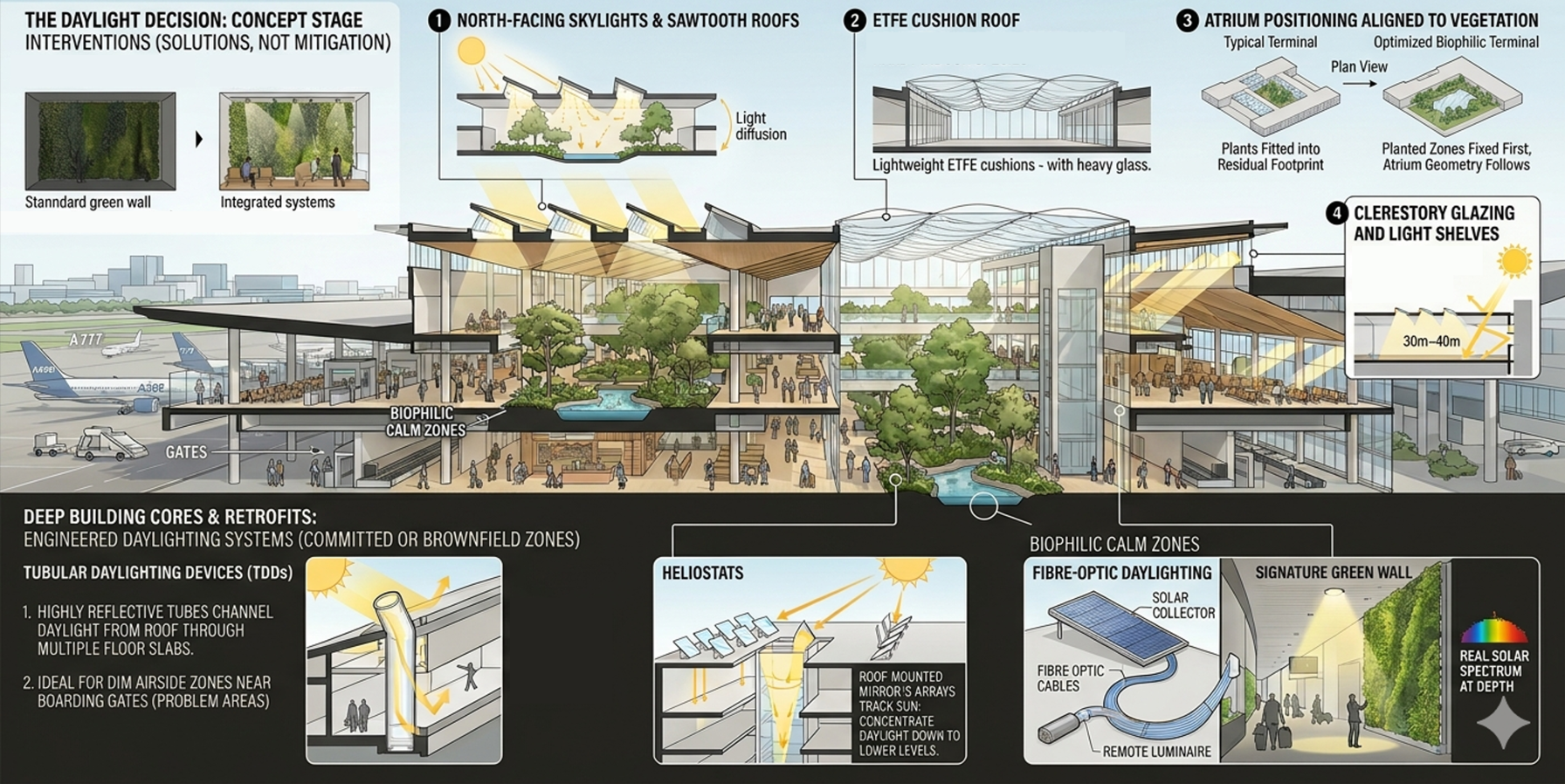
The intervention that actually solves the problem (not mitigate) is the concept design decision. That is the one that make biophilic design sustainable rather than survivable. There are several ways in which this can be achieved.
1. North-facing skylights and sawtooth roofs over planted zones deliver diffuse daylight without the solar gain or harsh shadow play of south-facing glazing. This is the default move when the planting brief is taken seriously at concept stage rather than retrofitted into the section later.

2. Atrium positioning aligned to vegetation, not the other way round. Most Indian terminals position the atrium for circulation and concession sightlines, then drop planters into whatever footprint is left over. The result is photogenic landscape clusters at the dim edge of the daylight cone. The planning move is to fix the planted zones first and let the atrium geometry follow.

3. Clerestory glazing and light shelves push usable daylight thirty to forty metres in from the perimeter. A standard terminal floor plate is too deep to be daylit from façade glazing alone. The interior could carry the same canopy if the section had been designed for it.

4. ETFE cushion roofs deliver the spectrum and intensity that hardy indoor species actually need, at a structural penalty far lower than equivalent glazing. The technology is mature and remains under-used in Indian terminal design.

When the building is committed but not yet finished, or when a brownfield expansion offers a discrete intervention zone, three engineered options are worth specifying.
1. Tubular daylighting devices — reflective tubes that channel rooftop daylight down through the slab — are standard in offices and industrial sheds and almost absent from Indian airport terminals. They are practical for the dim airside zones near boarding gates that operators most often cite as problem areas. Capital cost is modest, and the retrofit pathway is real provided the roof is accessible and the slab penetrations can be coordinated with structure.
2.Heliostats — roof-mounted mirror arrays that track the sun and redirect daylight into deep building cores — are deployed in museum atria and transport interchange projects internationally.
3.Fibre-optic daylighting systems collect rooftop sunlight and pipe it through fibre to luminaires that emit the real solar spectrum at depth. Niche and expensive, but a credible engineering option for high-value zones like a signature green wall in a deep concourse or a centrepiece tree in a darker waiting zone.
Conclusion
What this comes down to is the moment in a project when the lighting question is raised. Biophilic design at an airport terminal is not really a horticulture programme. It is a daylighting decision made at concept stage that a horticulture programme then operationalises for the many decades. Operators, developers and design leads commissioning new terminals should set a biophilic vision at the outset of the project, bring their horticulture teams into the architectural conversation before the building envelope is fixed. The cost of getting this right at concept is negligible. The cost of getting it wrong is paid every operating quarter for the life of the asset.