India’s aviation story is not just about metro hubs and large, glass‑and‑steel terminals. The growth is actually in the smaller places: the tier‑2 and tier‑3 cities providing regional connectivity beyond the metros. As the Centre pushes ahead with a modified UDAN scheme and a pipeline of roughly 100 new and revived airports, one question will determine whether this expansion is sustainable: can we build and run truly low‑cost terminals that are lean and efficient?
For too long, “low‑cost airport” has been heard as cheap and low quality terminal. In reality, a low‑cost terminal is best understood along three dimensions.
- Lower CapEx
- Lower OpEx
- Higher Efficiency
By no means – lower level of service.
The starting point, therefore, is not a drawing but a strategic business model. Any tier‑2 or tier‑3 terminal must first answer three basic questions.
- What is its positioning?
- What are its constraints?
- What level of service is it promising?
Once the economic logic is clear, sizing and phasing become the crucial design decisions. Many of the new airports risk repeating a familiar mistake: building for a 15‑year horizon based on the opportunistic forecasts.
A low‑cost approach does the opposite. It uses realistic, conservative traffic projections to size processing areas and takes seriously the idea of modularity: building an initial 0.5–1 million passengers per annum (MPPA) module that can be replicated or extended as demand grows, instead of a single oversized structure that stands half‑empty for years. Site planning is done with future phases in mind, ensuring that additional halls or fingers can be added without tearing up aprons or access roads.
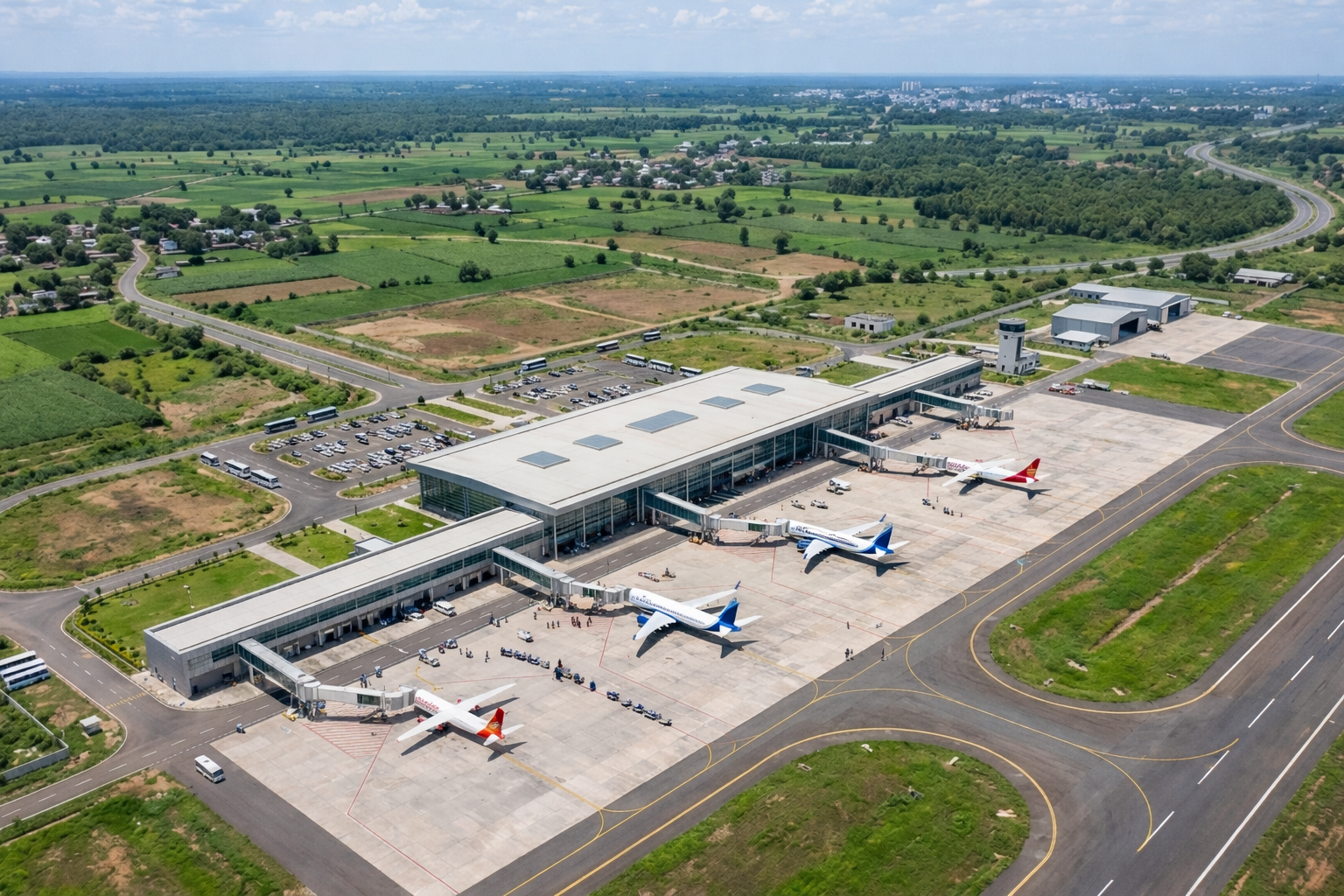
In physical terms, this often leads to a simple linear terminal, especially for the 0.5–5 MPPA band where most Indian regional airports will sit for some time. A single‑storey, linear hall with aircraft parked parallel on the airside allows short walking distances, intuitive flows, and easy incremental expansion. We have examples of such flexible modular design terminals in India. Terminal 1 of Kempegowda International Airport initially designed for 11 MPPA, incrementally expanded and optimized for 30 MPPA. It is a single level linear terminal built on the concept of modularity and functionality, whose capacity could be easily augmented basis the demand growth. More complex typologies—fingers, satellites, hybrids—only make sense when aircraft stands or land are genuinely constrained. For most tier‑2 and tier‑3 locations, they are unnecessary complications that add cost without benefit.
With the typology in place, the design philosophy should be to strip down to essentials, then add selectively where the business case is strong.
Essentials are non‑negotiable: level of service, safety and regulatory requirements, accessibility and passenger flows are a must.
Efficiency enablers come next: consolidated processing zones rather than scattered islands, minimal level changes, and clear wayfinding can shrink the footprint and staffing levels while actually improving the passenger journey.
Good-to-have elements like retail, premium lounges, large parking structures, etc enter the conversation in the end.
Operating cost and resilience are where low‑cost terminals can truly differentiate themselves. In India’s hot climates, there is no reason every square metre of a building must be mechanically cooled. A more intelligent approach uses high roofs, deep overhangs, shaded verandahs and cross‑ventilation to keep public halls comfortable for most of the year, could be looked at. This not only reduces energy spend but also cuts the complexity and maintenance burden of HVAC systems.
Operational flexibility is another underrated design parameter. Smaller airports tend to see peaky, unpredictable traffic, often driven by a handful of scheduled flights, charters and seasonal tourism. Designing processing areas, seating and ancillary spaces to be reconfigurable, may be by using movable partitions, multi‑use halls and flexible counters allows operators to cope with these peaks without overbuilding. With technology emergence and adoption, like DigiYatra, self‑service check‑in and bag drops, body scanners in security, such flexibility will also make it easier to retrofit without major civil works.
Another important aspect of making low-cost terminals appealing is their identity. Using local materials—brick, stone, timber, traditional screens—in simple forms gives a sense of identity at modest cost. Programming retail and F&B with regional brands rather than generic chains can support local economies while creating non‑aeronautical revenue streams. Most importantly, the airport must be thought of as part of a wider urban and economic system. Its master plan should align with city land‑use, industrial corridors and logistics nodes, with an emphasis on affordable surface connectivity—buses, shared mobility, eventual rail—rather than just private cars. For many smaller cities, getting this interface right will have more impact on usage and public perception than any architectural flourish.
Taken together, these elements can be distilled into a simple strategic playbook for India’s next wave of airports. Right‑size and phase capacity by designing for what you realistically need in the next five to seven years. Default to simple, linear layouts and only move up the complexity ladder when forced. Treat non‑negotiable level of service, safety and regulatory needs as sacred, but challenge every other line item for its impact on lifecycle cost and service. Design for low operations and maintenance (O&M) through climate‑sensitive architecture and robust systems, and keep operational flexibility at the heart of spatial planning. Finally, give each terminal a grounded sense of place and connect it tightly to the city it serves.
If Indian planners, state governments and private operators can internalise this mindset, the country’s regional aviation push has a chance to be both expansive and financially sustainable. It can bring the benefits of air connectivity to dozens of emerging cities without saddling future taxpayers and operators with infrastructure they cannot afford to run.