The rise in Indian population income levels and changing lifestyle has given the Indian airports F&B sector a chance to expand and tap into new F&B segments. The Indian airport F&B sector continues to invite huge amounts of interests, investment and still sees high growth and opening of new chains at a rapid pace. The Income Per Pax (to the operator) CAGR at Indian airports in the 5 years prior to COVID-19 have been 10-20 percent.
Prior to COVID-19, airports F&B concepts were evolving by creating food zones that have a clean and sense of place, creating an illusion of street food markets. New evolving trends uses robots to create healthy fast food at affordable prices with speed of service. Such trends are likely to be visible in airports over the next 5 years.
The Indian airports F&B units tend to have by far the highest sales densities (i.e. sales volume over area), due to the small size of the units and high sales, even without well-wishers, as they are not permitted to enter the terminal building. However, there is increasing evidence of retail and F&B plazas being developed at airport landside areas to accommodate the visitors and encourage city dwellers. E.g. Bangalore airport commissioned Quad which is an open-air commercial plaza outside Terminal 1, abutting the terminal forecourt.
The penetration rate (defined as the % of total addressable market of passengers that end up buying) is substantially higher at Indian airports than their global counterparts – 35-40 percent at some airports, basically 1 in every 2.5 passengers. Globally, this is more like 1 in 10 passengers though this varies significantly across regions.
What’s driving the higher spends and penetration rate?
(1) Partly because Indians closely link food to the experience of travel, accentuated by the excitement of first-time leisure travel (remember the air travel penetration in India is still very low) even though pricing maybe through the roof.
(2) The high percentage of LCC traffic with a sandwich in a box concept. BLR is testament to the hot food breakfast rush at the Tiffin place in Terminal 1. Filter Coffee anyone?
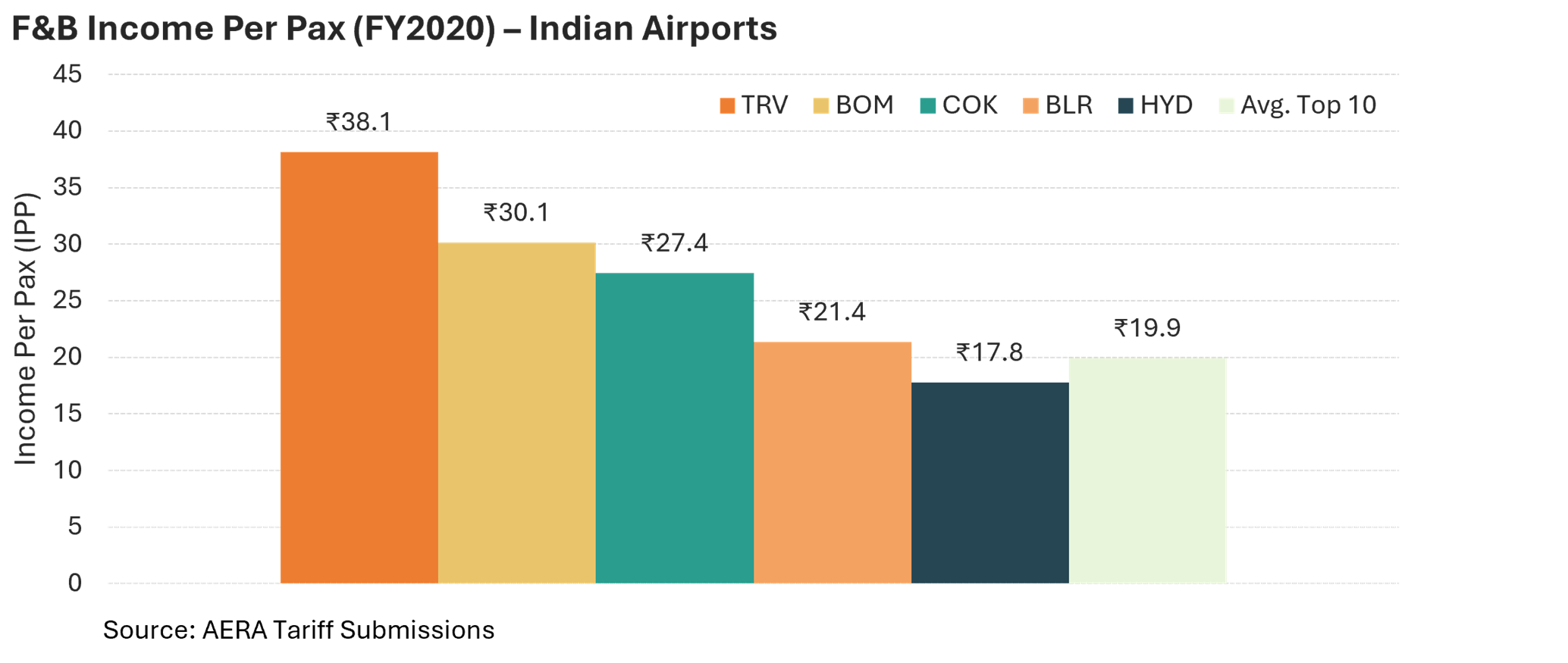
Trivandrum, Mumbai, Cochin, Bangalore and Hyderabad are clearly the food capitals when it comes to their airports in terms of spend metrics. At TRV and COK, the higher % of foreign bound traffic has a direct impact on the higher dwell times within the terminal and the average transaction value. Penetration rates at Bangalore and Mumbai are among the highest in the country.
Beverages forms the bulk of the sales – around 70% by revenue as per a report by India Retails & Hospitality Private Limited. The Millennials and now the Gen Alpha value ease, engagement, entertainment, and wellness-oriented option over other factors.
The upcoming Greenfield airports – Noida and Navi Mumbai – aim to create a sense of place for its passengers. Navi Mumbai is positioning its F&B as an experience rather than a stopgap by offering passengers a taste of Mumbai’s culture.
When it comes to F&B, the possibilities are endless – and Indian airports are pulling out all the stops to get travellers to indulge.